



You’re sending SMS campaigns, but are they actually driving conversions? Many businesses assume that a Your latest SMS campaign brought in orders. But was it a good result for the number of people you reached?
That’s what your SMS conversion rate helps you assess. Klaviyo’s 2026 benchmarks report order rates of 0.27% for campaigns and 1.9% for automated flows. Those are useful reference points, provided you’re comparing the same type of message and counting purchases the same way.
If your rate is lower than expected, the next step is to find where shoppers lose interest: in the text, after the click or while waiting for an answer. That tells you what to improve.
Key takeaways
- Compare campaigns with campaigns and flows with similar flows.
- Check whether a rate divides purchases by messages, recipients or clickers.
- Keep attribution settings consistent when comparing results.
- Use clicks, purchases, replies and opt-outs to choose the next change. Standard SMS does not support open tracking.
What is SMS conversion rate?
SMS conversion rate tells you how often a text leads to the action you want. For this guide, that action is a purchase. Signups and replies matter too, but they answer different questions.
A common purchase calculation is:
SMS purchase conversion rate = (Attributed purchases ÷ Delivered messages) × 100
An attributed purchase is one your reporting rules credit to SMS, based on the qualifying interaction and how soon the shopper bought.
One detail matters here: orders and buyers are different counts. A customer placing two orders is still one buyer. Klaviyo’s analytics glossary defines placed order rate using unique ordering recipients divided by delivered messages.
One send, three different percentages
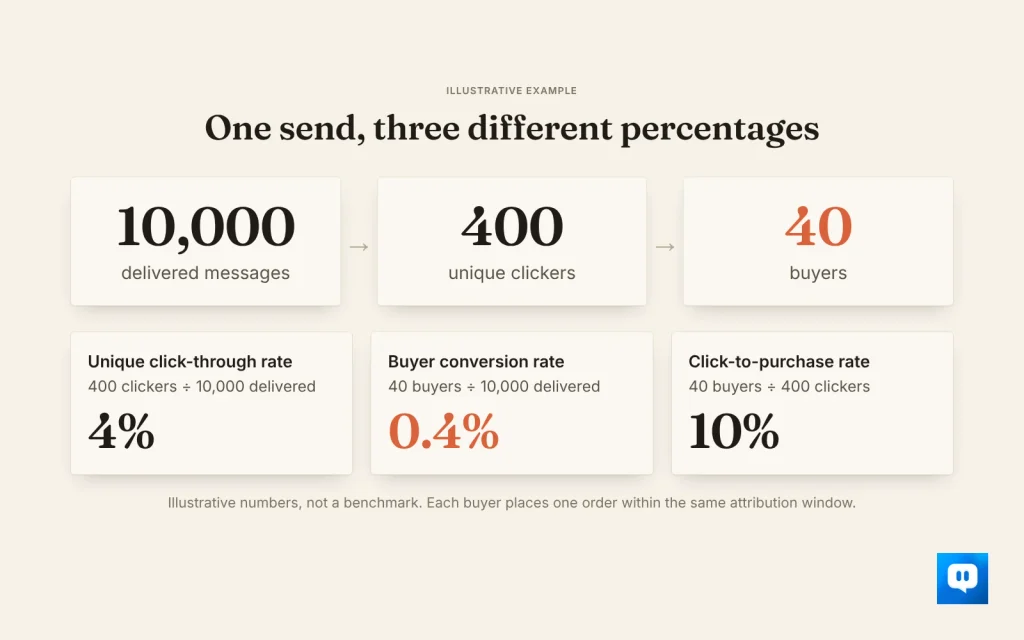
Imagine one text delivered to each of 10,000 subscribers. Of those people, 400 click and 40 buy after clicking, within the same attribution window. Each buyer places one order. Here’s how that illustrative send looks:
| Metric | Calculation | Result |
| Unique click-through rate | 400 clickers ÷ 10,000 delivered messages × 100 | 4% |
| Buyer conversion per delivered message | 40 buyers ÷ 10,000 delivered messages × 100 | 0.4% |
| Click-to-purchase rate | 40 buyers who clicked ÷ 400 unique clickers × 100 | 10% |
A 10% click-to-purchase rate and a 0.4% buyer conversion rate can describe the same send. The first tells you what happened after the click; the second tells you how many delivered texts led to a buyer.
With several texts per subscriber, messages and people become different counts too. Our SMS marketing analytics guide covers those distinctions and the wider reporting picture.
What is a good SMS conversion rate for ecommerce?
Klaviyo separates campaigns from automated flows in its 2026 SMS benchmark report:
| Reported order rate | Campaigns | Automated flows |
| Main benchmark | 0.27% | 1.9% |
| Top 10% | 0.61% | 3.92% |
These rates count unique recipients who placed an attributed order, divided by delivered messages. The report draws on more than 183,000 Klaviyo customers; it does not disclose collection dates or full weighting details, so use it as a vendor reference rather than an industry-wide average.
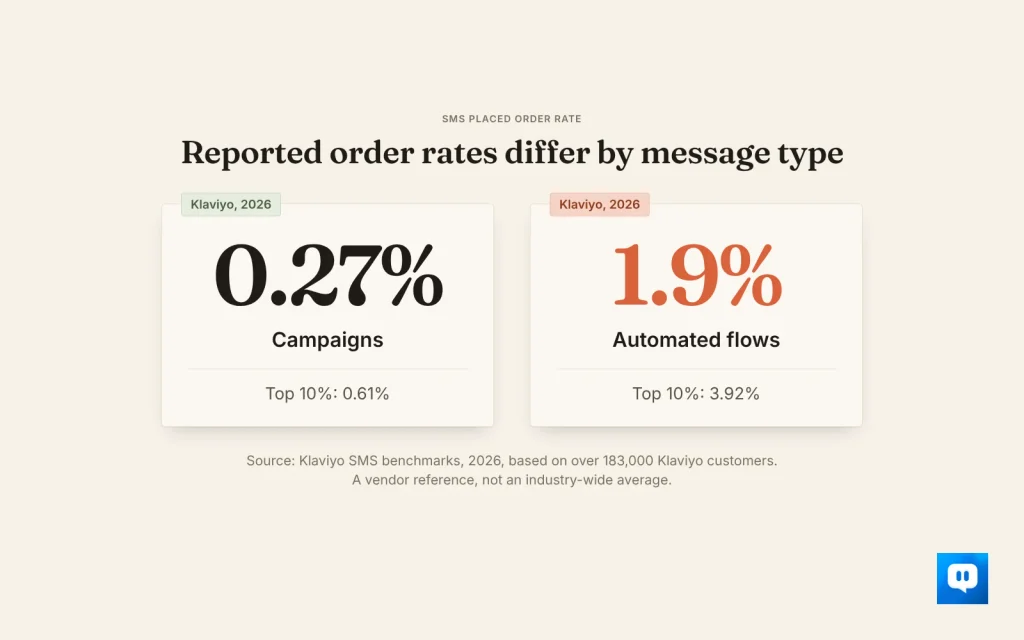
The gap makes sense when you think about who gets each text. A sale announcement reaches subscribers with mixed levels of interest. A cart reminder reaches someone who has already chosen a product and started buying. They should not have the same target.
Welcome, cart recovery and win-back messages also reach different moments. Our SMS flows guide explains those jobs; compare similar flows when judging your own results.
For adoption and broader engagement data, see our SMS marketing statistics article. Those figures provide context, while purchase benchmarks help you assess the path to an order.
Why your rate differs from a benchmark
Attribution changes which purchases get counted. Some reports credit purchases after delivery without requiring a click; others require a qualifying click. A longer attribution window also gives purchases more time to count.
That is why a change in reported conversion does not always mean shoppers behaved differently. The underlying rules may have changed.
TxtCart, an SMS marketing platform for ecommerce brands, gives Shopify merchants configurable attribution settings, including windows and stricter rule overrides for individual flows and messages. Keep those rules consistent when comparing results.
Seasonal context matters too. A Black Friday sale and a routine mid-year broadcast give shoppers different reasons to buy. Compare similar seasonal sends once their attribution windows have ended. Our Black Friday SMS planning guide covers the campaign planning behind them.
Your own comparable sends are often the most useful reference.
Where are you losing purchases?
If conversion is below your usual range, work back from the purchase. Did people receive the text? Did they click? What happened next?
| What you see | What to check first | Next action |
| Weak delivery | Failed-delivery reasons and contact quality | Check failed deliveries before evaluating the copy |
| Healthy delivery, few clicks | Segment relevance, offer clarity and the next step | Test one change to targeting or the message |
| Healthy clicks, few purchases | Destination, offer terms and mobile checkout | Follow the actual SMS link through purchase |
| Buying questions without purchases | Product uncertainty or unanswered replies | Answer the question or route it to your team |
| A rate jumps after a reporting change | Denominator, attribution rules, window and exclusions | Annotate the change and compare on the same basis |
| Conversion improves but total orders fall | Send volume and who received the message | Review order counts and revenue alongside the rate |
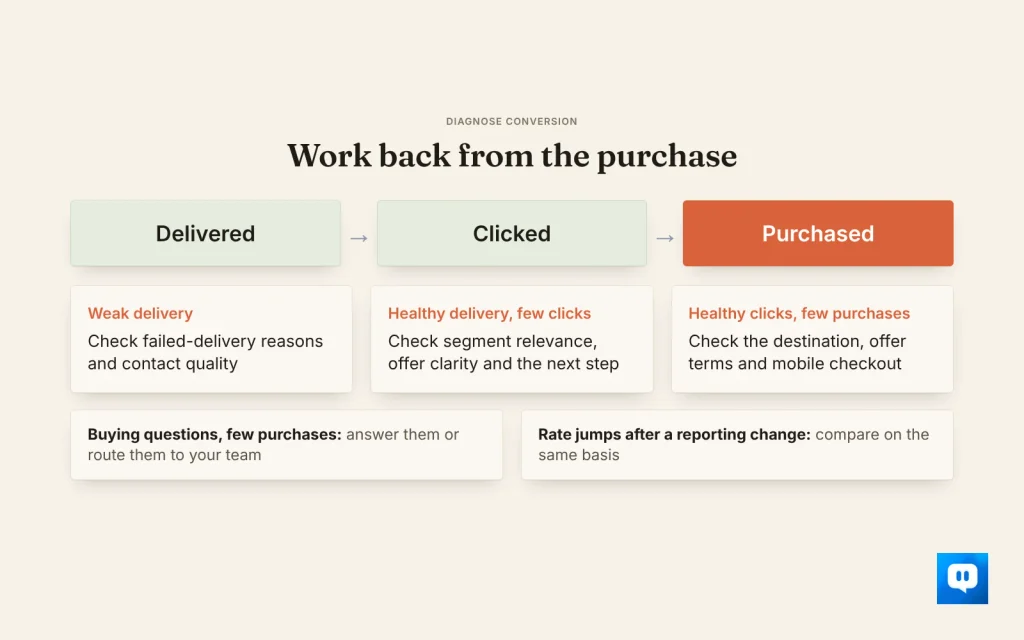
These patterns give you somewhere to start, rather than a verdict. Healthy clicks and weak purchases, for example, could reflect the destination, a different offer or a broader audience.
Our post-click friction diagnostic walks through the landing-page and checkout checks when interest falls away after the click.
How to improve your SMS conversion rate
Match the message to the subscriber’s intent
Someone who bought yesterday has a different reason to hear from you than someone who left checkout unfinished. Start there, before writing the offer.
SMS segmentation helps you separate those situations. TxtCart campaigns support included and excluded audiences, so you can focus a send on the relevant group and leave out people for whom the offer no longer fits.
If texts aren’t reaching people, review SMS list cleaning before sending more. Consent and opt-out handling remain part of a sound SMS marketing compliance process.
A smaller audience can produce a higher rate and fewer orders. Look at both before deciding that tighter targeting worked.
Make the offer and next step clear
The shopper should be able to tell what you’re offering and where the link leads without having to work it out.
An illustrative cart reminder could read: “Still considering the blue hoodie? Return to your cart: [cart link]. Reply if you have a question.” It names the item and gives the shopper a way back. Our abandoned-cart text examples offer other approaches.
When clicks are weak, revisit the SMS opening line and the action it invites. Include shipping costs or important offer restrictions before the click when they affect the decision. Concise copy helps only if the offer is still clear.
Personalized SMS messages work best when the context explains the recommendation. A relevant previous purchase gives you something useful to say; adding a first name cannot rescue a vague offer.
Continue the offer after the click
Open your text on a phone and follow the link. Can you find the promoted item, understand the offer and complete checkout?
A text about one hoodie can lose its purpose when the link opens a collection of fifty products. A discount feels less appealing when its restrictions appear only at checkout. Keep the promise in the text and the experience on the page consistent. For collection-wide promotions, clear product labels help shoppers distinguish eligible items from excluded products without opening every product page.
Check the economics too. A deeper discount might win more purchases while changing what each order is worth. Our SMS marketing ROI guide explains how to assess the return beyond the conversion percentage.
Answer questions while the shopper is considering a purchase
“Does this come in medium?” is a more useful clue than a low conversion rate on its own. The shopper is telling you what they need before they can decide.
Two-way SMS conversations let that question stay in the same thread. TxtCart’s AI Agent can search the Shopify catalog and check variant availability, such as whether the hoodie comes in medium and blue. It reports availability rather than exact stock counts.
If the question needs a person, Conversations gives your team the escalation reason and conversation history. Once someone intervenes in an AI-managed flow conversation, AI replies stop and the team handles the follow-through.
Count the purchase separately from the reply or AI resolution. Answering a question helps the shopper make a decision; it does not guarantee an order.
Test one change under consistent conditions
Let the problem choose the test. Weak clicks might call for a clearer offer; a timing concern might call for comparing SMS send times with similar subscribers and offers. Check for purchases before following up, so you don’t keep reminding someone who already bought.
Changing the audience, offer and timing together leaves you guessing about what helped. Choose one variable and use the same purchase measure and attribution conditions for both versions.
TxtCart supports A/B testing in flows. Our SMS A/B testing examples can help you choose a variable. Let the attribution window end, then assess purchases, revenue and opt-outs together. Small purchase counts can make a result unreliable, and an automatic winner is not proof of statistical significance.
Put the diagnosis to work with TxtCart
A benchmark can tell you that a flow deserves attention. Message-level reporting helps you see where to look. TxtCart’s Flow Summary Screen brings together sends, clicks, orders and revenue for the flow and its individual messages.
From there, the next change can be specific: adjust campaign targeting, test the message that gets overlooked or answer the product question that keeps appearing in replies. Compare the result with a similar send using the same reporting rules.
TxtCart supports that work, while your team owns the offer, accurate product information, checkout experience and human follow-through.
SMS conversion rate FAQ
What is a good SMS conversion rate for ecommerce?
Use a benchmark for the same message type and calculation. Klaviyo’s 2026 report lists order rates of 0.27% for campaigns and 1.9% for flows. Those references are not interchangeable with click-to-purchase rates or a universal target for your store.
How do you calculate SMS conversion rate?
For a delivered-message purchase rate, divide attributed purchases by delivered messages and multiply by 100. State whether you count orders or distinct buyers. For click-to-purchase, divide buyers who clicked and purchased within the window by unique clickers instead.
Is SMS conversion rate the same as click-through rate?
No. Click-through rate measures clicks; purchase conversion measures purchases. A text can earn clicks while the destination, offer or checkout leaves shoppers without completing an order.
Why do automated flows convert differently from campaigns?
Flows respond to a shopper action, such as joining a list or abandoning checkout. Campaigns can reach a broader group with mixed intent. Compare similar flow types as well, because a cart reminder and a win-back message serve different situations.
Why did my reported conversion rate rise without more orders?
A smaller denominator can raise the percentage even when orders stay unchanged. A broader attribution rule or window can also credit more existing purchases to SMS without creating additional orders. Check the counts and settings behind the rate before calling the change an improvement.
Explore Analytics to see how TxtCart connects reporting with your SMS program, or book a demo for a walkthrough of the workflow.