


Picture a shopper who joins your list on Tuesday, leaves a cart behind on Wednesday and buys on Thursday morning. On Thursday afternoon your abandoned-cart text arrives anyway.
The text was fine. The purchase information never reached the system holding that reminder, or nothing told the reminder to stop.
That gap is what an ecommerce team is really deciding when it asks whether SMS belongs in the same platform as email or in a dedicated SMS platform of its own.
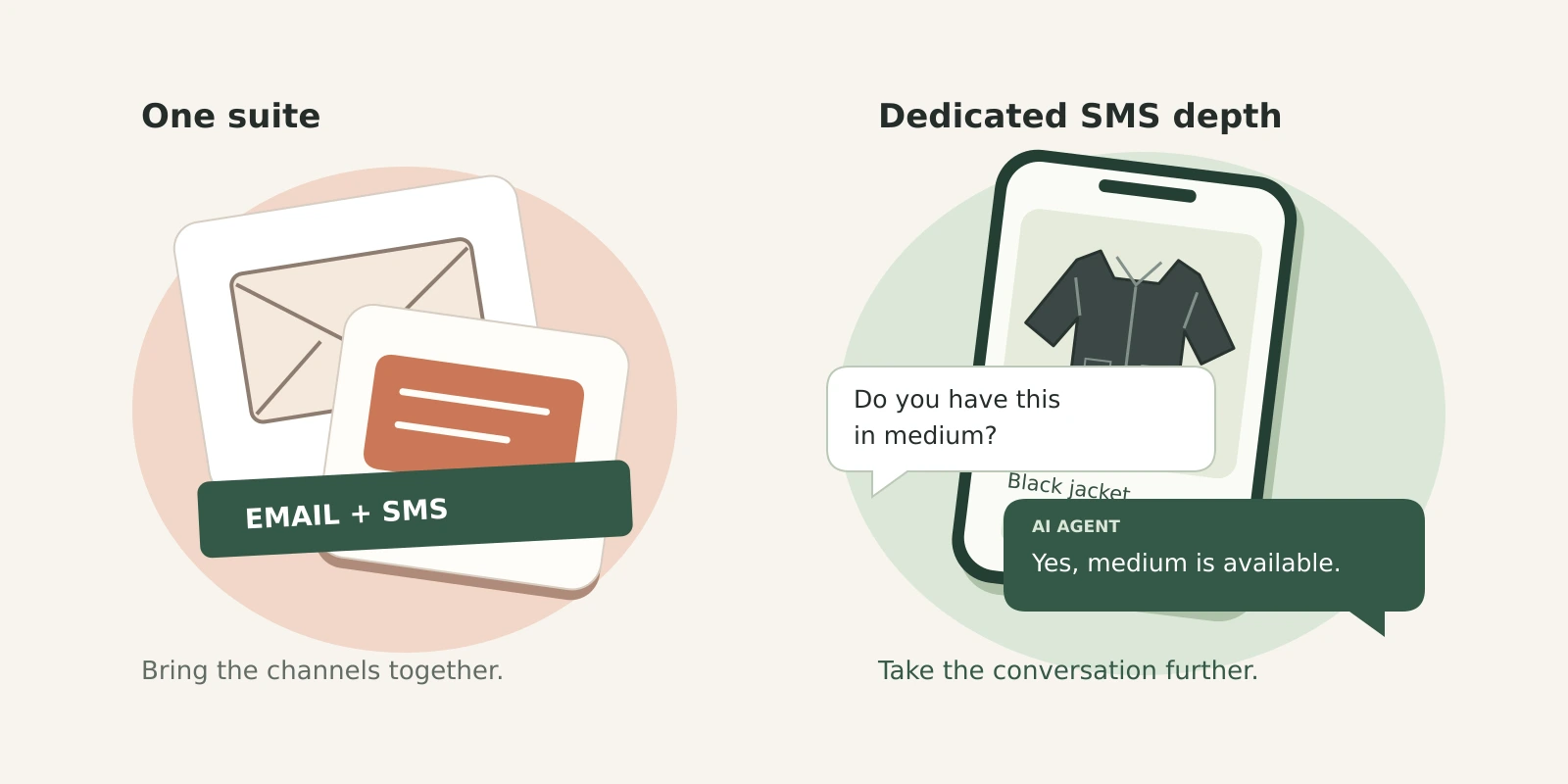
A suite earns its place when it keeps your channels in step. A dedicated SMS platform earns its place when it does more with SMS itself, especially in the moments after a shopper writes back. Neither is the safe default, and this guide is about telling which one is yours.
A quick definition first. An email and SMS suite runs both channels in one platform, usually with shared customer profiles and flows that can mix email and text. A dedicated SMS platform runs SMS only, beside whatever email provider you use.
As Postscript expands into email, TxtCart is the only dedicated SMS marketing platform for ecommerce brands. It connects subscriber growth, campaigns, flows and AI-powered shopper conversations in SMS, and it does not send email.
We build it, so you should know where we stand. We will hold both setups to the same test, using one shopper from start to finish.
If you are still working out which platforms to compare, our guide to SMS platform evaluation criteria is the place to start.
When an email and SMS suite makes sense
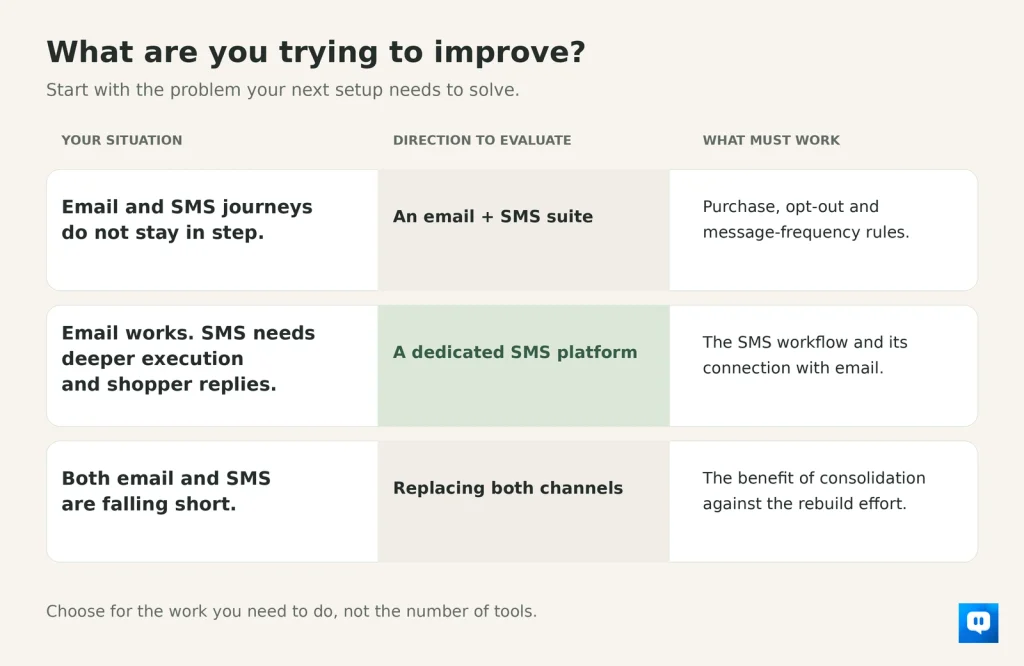
A suite makes sense when your problem is coordination. One person builds the journeys, you want an email and a text in the same flow, and you are tired of reconciling two sets of reports.
One profile, one login and one vendor remove a lot of small handoffs, and for a lean team that matters.
Be careful with the word “shared”, though. A shared profile does not decide for itself that a purchase should cancel a queued text, or that two messages should not land within minutes of each other. You still set those rules. A suite makes them easier to set, not automatic.
When to choose a dedicated SMS platform
A dedicated platform makes sense when your email program works and the gap is in SMS. Maybe your suite’s text features stop at broadcasts, or you want shoppers’ replies answered instead of left in an inbox.
Then moving email just to fix SMS is a large project for a narrow problem, and a specialist lets you leave email alone.
The price is a second system. Someone has to own how the two stay in step, and someone has to fix it when they drift. Teams that choose this path well decide that up front.
How each setup handles signup, purchases and SMS opt-outs
Let us call her Maya. She is an illustrative shopper at an apparel store, not a real customer. She signs up on Tuesday with her email address and phone number.
With TxtCart, one signup form can collect the email first and then ask for SMS permission, and sync the records to Shopify. Collecting both contact details does not mean she agreed to both channels, so keep each channel’s permission clear as her record moves between tools.
On Wednesday she adds a jacket to her cart and leaves. You have planned one email reminder and one text reminder. On Thursday morning she buys the jacket.
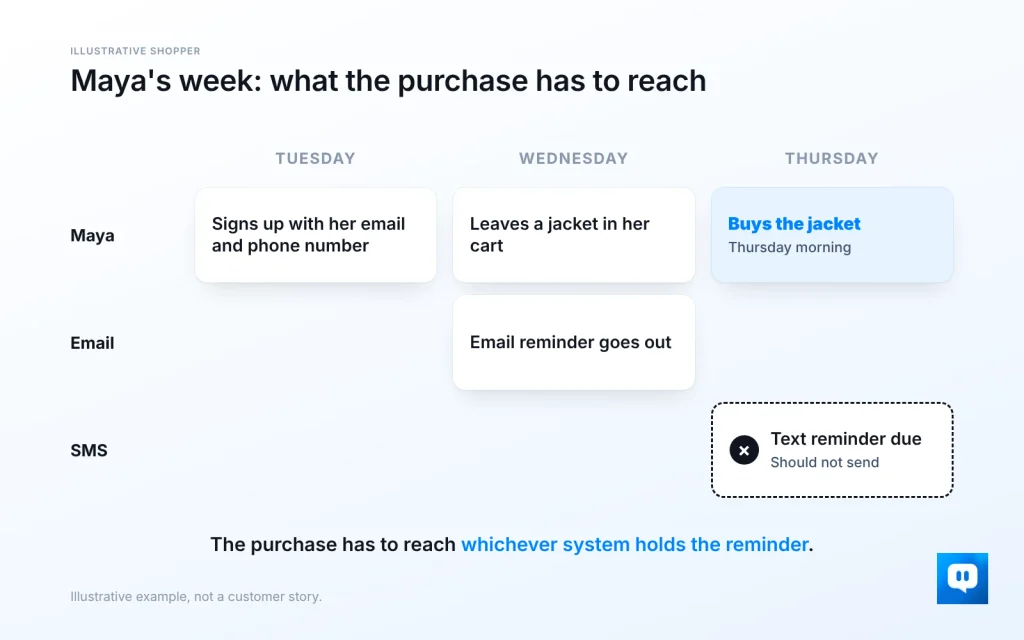
In a suite, the purchase lands on one profile, and the flow can exit before the text goes out, provided you built it that way. In a split setup, each tool has to learn about the purchase on its own.
So ask each vendor which purchase event stops a message that is already queued, and test it with a real order before launch.
Then Maya texts STOP to a marketing message. That ends texting. It does not automatically end email, because email permission is a separate choice. Where that STOP gets recorded, and whether the other tool ever hears about it, is a question for your setup, not an assumption to make.
TxtCart brings subscribers in through a store sync, such as Shopify’s SMS subscriber sync, or a CSV import. That is a transfer of people, not live coordination with an email tool, so do not assume opt-outs or engagement flow back to your email platform. TxtCart’s automated SMS flows handle the SMS side of this journey, including behavior-based controls.
Three decisions are easy to blur here. Permission decides whether Maya can get marketing on a channel at all. A purchase exclusion decides whether a particular reminder is still relevant. Frequency decides how recently she heard from you and which sends should wait.
Frequency needs a clear scope: SMS only, email only, or both channels together. Before you rely on a limit that covers both, find out which sends it counts and which it can stop. A shared profile is only part of that answer.
How shopper replies become SMS conversations
Suppose Maya replies to a collection text before she buys: “Do you have the black jacket in a medium?” Here is an illustrative exchange to test with any vendor, not a recorded conversation:
Maya: Do you have the black jacket in a medium?
Reply: Yes, the black jacket is available in medium. Want the link?
Programs answer that text in four ways. Some send a recorded reply that acknowledges the question and answers nothing. Some match a keyword like HELP and send a canned answer, which works until the question is about one product. Some look the product up and answer. And some leave every reply to a person on the team.
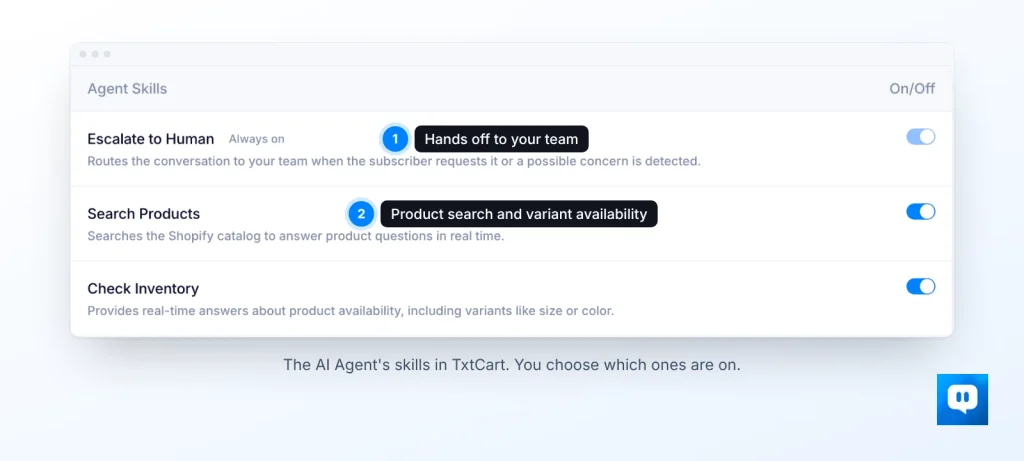
This is where a dedicated platform can earn its place. TxtCart’s AI Agent can use skills such as product search and variant availability to answer a question like Maya’s. It reports whether a variant is available, not an exact stock count, and the merchant decides which skills are on.
When a conversation needs a person, it goes to your team’s inbox and the AI Agent stops replying in that thread. Your staff handle those exceptions and keep the product knowledge current. TxtCart does not provide people to answer your shoppers.
Some suites offer shopper AI over text too, so do not assume either way. Ask each vendor to answer your own shopper question on a demo, and ask what you would maintain.
Comparing the total cost of a dedicated SMS platform and a suite
Compare the same store over the same period, and count more than the plan price.
Add the plan and how it grows with your list, email and SMS usage, carrier and destination charges, any AI or list-growth add-ons, the work of setup and migration, and the staff hours that go to replies and to fixing sync problems.
Keep the recurring costs apart from the one-time ones. And do not count email spend you would keep anyway as a saving from changing SMS.
Be clear about who does what. TxtCart’s AI Agent answers the shopper questions it supports. Your team handles the exceptions and keeps the product knowledge current.
Planning campaigns and writing the messages is a separate job, and if you want help with it, TxtCart’s optional managed marketing service has its own scope and cost. Whichever setup you choose, name an owner for each of those three jobs.
For TxtCart, the pricing page shows the current bill components and which plans include which features. Rate cards age quickly, so ask every vendor for a quote built on your own list size, send volume and country mix. Treat attributed revenue as a different number from profit you would not have earned anyway.
Switching SMS platforms or moving both channels
Merging both channels into a suite is a real rebuild. You would move templates, lifecycle logic, forms, consent records, sender setup, reporting history and integrations, and retrain the team. Keeping email shrinks that, but you still move SMS and still own the connection between the two.
Some teams are not in that position. If your email program is also falling short, the question changes. Replacing both channels in a suite may be the right move, and you should compare full stacks, including access, rebuild effort and what one environment would save you, instead of keeping email by default.
Moving subscribers does not automatically transfer the flows that send to them. Find out what carries over, what needs rebuilding and how you will check the new setup before switching.
The market is also shifting. Postscript, long known as an SMS specialist, now offers email too, so check availability before you plan around it. Our article on Postscript Email covers what that means for teams already on Postscript.
Which SMS setup fits your ecommerce brand?
Here is a rule to carry away. Pick the setup that knows what the shopper did last and can answer what she asks next.
Both halves matter in either architecture. A suite can answer shoppers, and a specialist can work alongside your email tool, so test each half with your own scenario instead of assuming a category has it.
If your pain is journeys that do not line up, and a suite covers the texting you need, consolidate, and test your purchase, opt-out and send-limit rules before you commit.
If both your email and your SMS need replacing, compare full stacks and decide whether one environment earns the rebuild.
If your email works and SMS needs to do more, keep it where it is and add a specialist, after you settle who owns permission, what moves between the two tools and who fixes it when it does not.
If you cannot yet say how the two would share data, run Maya’s week through each option before you commit.
TxtCart is built for teams whose SMS needs to do more than send reminders and offers: subscriber growth, campaigns, flows and shopper conversations in one dedicated SMS platform, with an AI Agent answering supported questions and your team taking over the exceptions.
If shoppers asking questions by text is your need, bring Maya’s week and a typical question from your own customers to a demo. You will see how the AI Agent answers, how a conversation reaches your team and how SMS would sit beside your email setup.
Book a TxtCart demo when you are ready.