



Choosing an SMS marketing platform gets easier once you stop comparing feature lists and start comparing how each platform will run inside your business.
The right choice should fit your Shopify store, your SMS goals, your compliance process, the way your team works and the amount you can afford as message volume grows. It should also give you a clear way to judge whether the channel is working.
That is the standard to use. A longer feature list, a lower starting price or a bigger brand name does not automatically make one platform a better fit.
Quick answer: what should you evaluate?
Start with these seven questions:
| Evaluation area | Question to ask | Why it matters |
| Shopify and implementation fit | Does the platform connect cleanly to the Shopify data, events, catalog, and tools your program depends on? | A platform that requires workarounds creates operational cost before the first campaign is sent. |
| Subscriber growth | Can you collect consented subscribers, track acquisition sources, segment the list, and manage list quality? | A messaging program cannot grow if list growth and consent are treated as afterthoughts. |
| Campaigns and flows | Can the platform handle both one-time campaigns and behavior-triggered lifecycle messages? | Lifecycle flows respond to subscriber and customer behaviour automatically and often become the program’s most consistent revenue driver. |
| Two-way conversations | Can shoppers reply, get useful answers, and reach a human when needed? | Conversation capability matters when shopper questions influence conversion or support load. |
| Compliance and deliverability | Can your team manage consent, opt-outs, message policies, and sending practices in a repeatable way? | Compliance is a process responsibility, not a checkbox that a vendor can remove from your team. |
| Reporting and attribution | Can you understand what happened after a message was sent, including the attribution window and limitations? | Open and click rates are not enough for a revenue-oriented program. |
| Total cost and operating effort | What will you pay as message volume, subscriber count, support needs, and program complexity grow? | The cheapest starting plan may not be the lowest-cost operating model. |
A useful shortlist should explain how each platform fits your program, not just whether it contains a particular feature.
What should an SMS marketing platform help you do?
At a basic level, an SMS marketing platform helps a brand collect consented phone numbers, organize subscribers, run campaigns and automate lifecycle flows.
For a Shopify store, that is only the starting point. A useful platform should also help you respond to what shoppers do. That may include welcoming a new subscriber, following up on an abandoned checkout, sending a back-in-stock alert, promoting a launch or answering a question before it costs you the order.
These jobs fall into three broad groups:
- Subscriber growth: collecting permissioned subscribers and keeping consent records organized.
- Marketing execution: running campaigns, flows and behavior-triggered messages.
- Shopper interaction: handling replies and questions instead of treating every text as a one-way broadcast.
Some tools do one of these jobs well. Others try to cover the whole SMS program. Your first decision is which jobs actually matter to your brand.
Start with your SMS program goals
The right platform depends on what you’re trying to run. Before you start demoing anything, get honest about which of these describes your situation:
Basic broadcasts. If you only need occasional campaigns and promotions, prioritize a simple setup and low commitment over automation depth.
Lifecycle automation. Welcome, cart-recovery, post-purchase and win-back programs need a real flow builder with triggers and branching, not just scheduled sends.
Two-way conversations. If shoppers need to reply and get useful answers, test the conversation itself rather than taking “AI” at face value.
Managed execution. When the internal bandwidth is not there, compare providers on the strategy, copy and optimization work they actually own, not just the software they provide.
A broader email-and-SMS suite. One tool can make both channels easier to manage, but only if its SMS capability is deep enough for the program you want to run.
Most stores are a mix of the first three. Knowing which one dominates changes what you should weigh most heavily below.
The criteria that matter when comparing SMS platforms
1. Shopify fit and implementation
An app-store listing proves that a connection exists. It does not tell you whether the platform can use the store data your program depends on, or how reliably that data arrives.
The platform needs to work with the events and data behind the messages you want to send, such as checkout activity, orders, customer records, product information and inventory changes. Setup effort matters too, especially before those workflows become usable.
Use the demo to pin down:
- Which Shopify events can trigger a message or flow?
- How quickly does store data appear in the SMS platform?
- Can the platform use product, order and customer data for segmentation?
- Who owns implementation, testing and troubleshooting?
- What happens if a Shopify event fails or arrives late?
The goal is not to find the platform with the longest integration page. It is to confirm that the Shopify data you depend on will support the exact workflows you plan to run.
2. Subscriber growth and list management
List growth is not simply a race to collect more phone numbers. You need to know where each subscriber came from, what they agreed to receive and whether the list is attracting people who want to hear from the brand.
Review the collection options available across your store, checkout and campaigns. Source data and consent status should stay attached to the subscriber record.
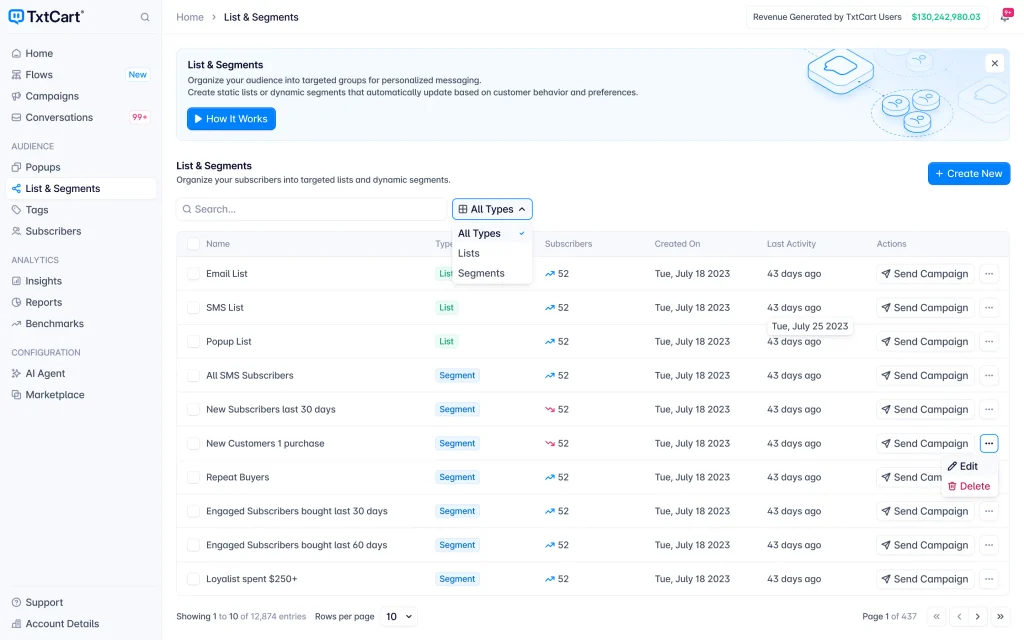
The platform should make it easy to:
- Create and test signup forms or popups
- Track the source of each opt-in
- Keep SMS consent separate from email consent
- Segment subscribers by behavior, purchases and signup source
- Sync consent changes correctly across Shopify and connected tools
- Make suppression and unsubscribe status easy to audit
For more on the collection side, see our guide to collecting phone numbers for SMS marketing.
3. Campaigns, flows and triggered messages
Campaigns and flows solve different problems.
A campaign is a scheduled message sent to a selected subscriber segment, such as a product launch or limited-time promotion. A flow is an automated sequence triggered by an event or change in customer behavior, such as a new opt-in or abandoned checkout.
A platform can feel simple for one-time sends and become awkward once the flow library grows. During the demo, have the team build, test, approve, pause and troubleshoot both campaigns and flows.
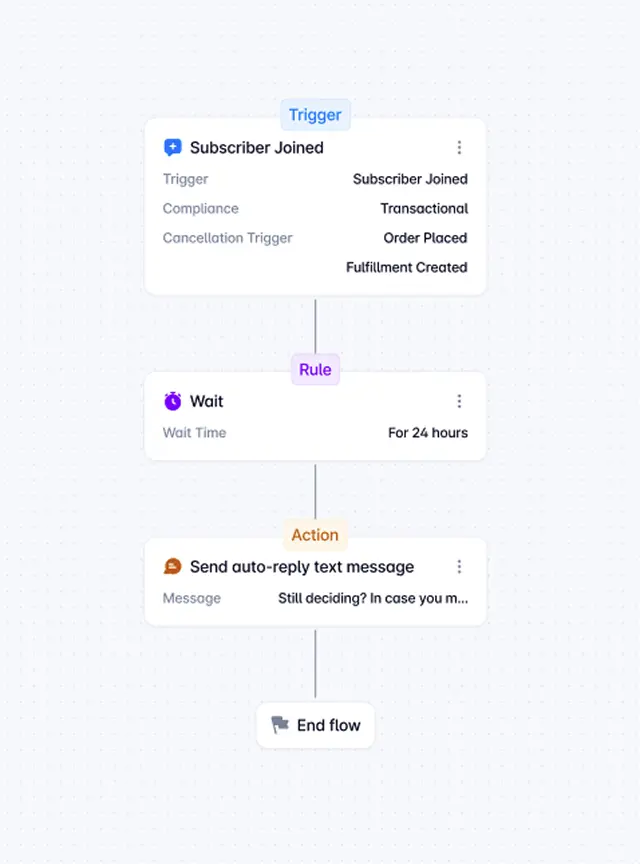
Focus on:
- The events and conditions available for triggers
- Branching and subscriber or segment-exclusion controls
- Message previews and test sends
- Time-zone handling and quiet-hour controls
- Versioning, approvals and change history
- Reporting at the campaign and flow level
- How easily a teammate can understand an automation they did not build
The cleanest demo is not always the easiest system to operate six months later.
4. Two-way conversations and AI
Two-way SMS matters when a shopper’s reply can change the outcome.
A customer may want to know whether an item fits, when an order will arrive, which product to choose or whether a promotion applies. A one-way platform can send the original message, but it may leave those replies in an inbox for the team to handle manually.
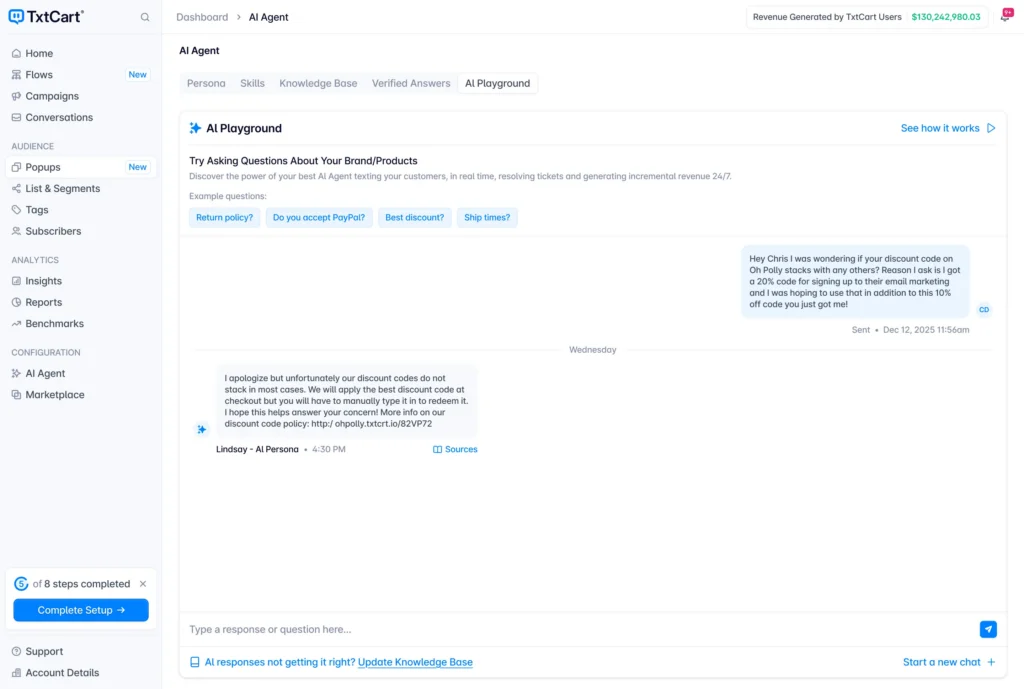
A conversational AI label tells you very little on its own. Test the actual experience:
- Which types of questions can it answer?
- What information can it use when replying?
- Can it recognize when a person needs to step in?
- How are incorrect or low-confidence answers handled?
- Can the team review conversations and change the underlying guidance?
- Which actions can it take, and which require human approval?
- How does it handle opt-out language or sensitive requests?
Run the same realistic shopper questions through every platform you are considering. The quality of the answer, the handoff and the controls around it matter more than the word “AI” on the feature page.
5. Compliance and deliverability operations
No platform can remove a brand’s legal responsibility for its SMS program. It can, however, make responsible operation easier or harder.
The platform should help you collect and retain consent information, honor opt-out requests, manage suppression, account for recipient time zones and keep an auditable record of changes. The FCC requires callers and texters to honor revocation requests in a timely manner, while Shopify’s SMS guidance limits marketing sends to customers who have opted in and points merchants to country requirements and quiet hours.
Get clear answers to:
- What consent information is stored, and where can we export it?
- How are unsubscribe requests detected and processed?
- How quickly do suppression changes apply across campaigns and flows?
- How are quiet hours handled across different locations?
- What sender-registration work is required before launch?
- What tools help diagnose filtering or delivery problems?
- How does the platform update its controls when rules or carrier requirements change?
Use the platform’s answers as an operational check, not legal advice. Your requirements will depend on where you send, what you send and how subscribers joined the list. Our TCPA compliance guide and SMS quiet-hours guide cover these topics in more detail.
6. Integrations and data flow
Your SMS platform will probably sit beside email, customer support, loyalty, reviews or analytics tools. The question is not how many logos appear on the integrations page. It is whether the right information moves between the systems you actually use.
Choose two or three real workflows and trace them end to end. For example:
- A customer opts into SMS at checkout. Where is that consent stored?
- A shopper buys after receiving both an email and a text. How is the order attributed?
- A subscriber opts out by text. Which other systems receive the change?
- A support conversation reveals a product issue. Can the team find that conversation later?
Pin down what syncs in real time, what runs on a delay and what needs custom work. Your team should also know which system remains the source of truth for consent, customer data and revenue reporting.
7. Analytics and revenue attribution
The dashboard should help your team decide what to change, not just produce a larger revenue number.
Before comparing reported ROI, compare the rules behind it. Platforms may use different attribution windows, event logic and methods for assigning an order to a message. Two dashboards can report different revenue from the same store activity without either number explaining the whole story.
Have each vendor show you:
- How campaign, flow and conversation revenue is attributed
- The attribution window and whether it can be changed
- How refunds, cancellations and repeat purchases are treated
- Whether the same order can be credited to more than one channel
- How opt-outs, failed sends and delivery status are reported
- Whether raw data can be exported for independent analysis
Agree on the measurement model before you compare results. Otherwise, the platform with the most generous attribution rules may look like the strongest performer.
8. Support, scalability and data ownership
Support is part of the product when a live campaign fails or a migration stalls.
Start with what is included at your expected plan level. Confirm who handles setup, how support is delivered, when strategy help becomes available and which response times are actually committed.
Before committing, cover what happens after onboarding:
- Can the system handle your expected message and subscriber volume?
- Do permissions support everyone who needs access?
- Can you export subscribers, consent records, templates and performance data?
- What happens to your number and message history if you leave?
- Is there a contract, minimum commitment or notice period?
- Who helps rebuild flows and verify the new setup during a switch?
A platform should not become difficult to leave simply because it became central to the program.
Read more: We Tried The 10 Best SMS Apps for Shopify (Our Review)
How to compare SMS pricing properly
Start with the total cost of the program, not the lowest advertised plan.
| Cost category | What to check |
| Platform fee | Monthly or annual subscription, plan limits, and required minimums. |
| Message cost | SMS and MMS rates, overages, volume tiers, and country-specific pricing. |
| Carrier fees | Whether carrier charges are included, passed through, or estimated separately. |
| International messaging | Country coverage, local rules, sender requirements, and rate differences. |
| Contracts and commitments | Annual terms, minimum spend, cancellation rules, and number-porting conditions. |
| Service and implementation | Onboarding, managed execution, strategy, migration, custom work, or support fees. |
| Data and usage growth | How cost changes as subscribers, sends, replies, and automation increase. |
| Internal operating cost | The staff, agency, or contractor time required to run and improve the program. |
TxtCart’s current pricing page combines a monthly plan with usage-based SMS and MMS charges. The AI Agent is priced at $0.99 per resolution, while managed service and specialist add-ons are priced separately. Rates and packaging can change, so use the current TxtCart pricing page when evaluating vendor-specific cost.
Do not compare only monthly platform fees. Model at least three scenarios: current usage, expected growth, and the operating model you will need if the program becomes a meaningful revenue channel.
Questions to ask during a demo or trial
Use a demo or trial to test the work your team actually needs to do. A polished interface is not proof that a platform fits your program.
Setup and data
•What can we connect to Shopify without custom development?
•Which events and customer fields are available immediately?
•How are existing subscribers, consent records, phone numbers, and flows migrated?
Campaigns and flows
•Can we build a welcome flow, cart flow, post-purchase flow, and win-back flow during the trial?
•How do exclusions, quiet periods, branches, and frequency limits work?
•Can we see the difference between campaign and flow performance?
Conversations and support
•What happens when a shopper replies with a question the system cannot answer?
•How does a human review or take over a conversation?
•Which support and service levels are included in each plan?
Reporting and cost
•What is the attribution window for revenue reporting?
•Which charges appear on the invoice, and which carrier or service fees are separate?
•What would our bill look like at current, expected, and high-growth volumes?
Switching and ownership
•What can we export if we leave?
•Who owns our subscriber records, consent history, templates, and reporting data?
•What happens to our number, flows, and automations during migration?
SMS platform evaluation scorecard
Use this scorecard to compare shortlisted platforms. Give each criterion a score from 0 to 2: 0 means the platform does not meet the need, 1 means it partially meets it or requires workarounds, and 2 means it meets the need clearly with evidence.
| Criterion | Evidence to collect | Score |
| Shopify and implementation fit | Working integration, available events and fields, setup ownership, migration path | 0–2 |
| Subscriber growth and consent records | Opt-in surfaces, source tracking, segmentation, suppression, exportability | 0–2 |
| Campaigns and flows | Required templates, triggers, branches, exclusions, testing, maintainability | 0–2 |
| Two-way conversations | Reply handling, automated assistance, human escalation, conversation reporting | 0–2 |
| Compliance and deliverability operations | Consent, opt-out, records, controls, carrier and sending support | 0–2 |
| Analytics and attribution | Definitions, windows, campaign/flow reporting, limitations, exports | 0–2 |
| Total cost | Platform, message, carrier, service, implementation, and internal operating costs | 0–2 |
| Support and scalability | Onboarding, response model, permissions, growth capacity, managed options | 0–2 |
| Data ownership and switching risk | Export, number portability, history, flow migration, contract terms | 0–2 |
Which type of SMS platform fits your business?
You do not need to compare every tool in the market. First choose the type of platform that matches the program you want to run.
Simple broadcast tool
Choose this when occasional promotions or alerts are the main job and complex Shopify workflows are unnecessary. Simplicity should not come at the expense of list management or consent controls.
Shopify-focused SMS platform
This suits brands that want campaigns and automations built around ecommerce behavior. The decision comes down to the depth of Shopify data, flow controls and cart-recovery workflows.
Email-and-SMS suite
A suite can work well when the team values consolidation across both channels. Test whether SMS operates as a full channel or as a secondary add-on, since depth and cost may differ from a dedicated platform.
Conversational AI platform
This category matters when shopper replies and questions affect revenue or service. Compare answer quality, data access, safeguards, escalation and the oversight required.
Enterprise platform
Larger teams may need permissions, governance, support for multiple business units, service commitments and more complex integrations. Implementation effort and contract terms matter as much as the feature set.
Managed service
This fits a team that wants a provider to plan or operate much of the program. The scope should spell out what the provider owns, how decisions are approved, what remains internal and how performance is measured.
Where TxtCart fits
TxtCart is an AI-native SMS marketing platform for ecommerce brands that want to manage subscriber growth, campaigns, lifecycle flows, two-way shopper conversations and performance insights in one place. Brands can use it to grow their lists, automate key customer journeys, recover carts and understand what is driving results.
Two-way conversations are handled by TxtCart’s AI Agent. It can answer shopper questions and follow up across ecommerce journeys, with controls for knowledge sources, escalation, reporting and team oversight.
TxtCart may be a fit when:
•Shopify is the core commerce platform.
•SMS is a meaningful retention or conversion channel, not an afterthought.
•The team needs campaigns, flows, subscriber-growth tools, and reporting rather than one-way sending alone.
•Two-way shopper conversations could improve conversion or reduce repetitive manual work.
•The team wants a path from self-managed SMS to more guided or managed support as the program grows.
It may not be the right fit if your primary requirement is a developer-first messaging API, a broad email-first suite, a highly specialized enterprise governance model, or a fully independent managed agency relationship. The evaluation criteria above should help you make that decision based on what your program actually needs, rather than a generic “best platform” claim.
Final checklist before you choose
Before signing, make sure you can answer these questions:
- Which three jobs will this platform own for us?
- Does it work with the Shopify data behind those jobs?
- Can our team build and maintain the required campaigns and flows?
- Are two-way conversations useful for our shoppers, and how are they controlled?
- Can we audit consent, opt-outs and sending rules?
- Do we understand the attribution model?
- What will the platform cost at today’s volume and at the next stage of growth?
- What work belongs to our team, the vendor or a managed service?
- Can we export our data and switch without losing the program we built?
If the answers are clear, you have a defensible shortlist. If the answers depend on vague promises, keep looking.
Want to see how TxtCart handles the framework for your Shopify store? Book a demo.
FAQs
What should I look for in an SMS marketing platform?
Choose a platform that fits your Shopify data, subscriber-growth plan, campaign and flow requirements, compliance process, reporting model, team capacity and budget. If shopper replies matter, evaluate two-way messaging and AI controls separately rather than assuming every platform handles them well.
How much does an SMS marketing platform cost?
The total can include a platform fee, SMS and MMS usage, carrier charges, international rates, minimum commitments, support, AI or managed-service fees and implementation costs. Compare vendors using the same subscriber count and sending scenario instead of relying on starting prices.
What is the difference between an SMS campaign and an SMS flow?
An SMS campaign is a scheduled message sent to a selected subscriber segment. An SMS flow is an automated message or sequence triggered by an event, such as a new subscription, an abandoned checkout or an order update.
When does two-way or AI-powered SMS matter?
It matters when shopper replies can affect the sale or experience. Common examples include questions about product fit, shipping, promotions and abandoned items. Test how the platform answers, when it escalates to a person and how your team can review and correct its behavior.
What compliance controls should an SMS platform provide?
Useful controls include consent records, suppression management, opt-out processing, sender-registration support, quiet-hour handling and an audit trail. These tools support your process, but they do not replace legal review or remove the brand’s responsibility for its messages.
What should I check before switching SMS platforms?
Confirm how subscribers, consent records, sending numbers, flows, templates and historical reporting will move. Agree on testing, cutover and rollback steps before the old platform is disconnected. Also confirm what data you can export if you need to switch again later.