



If your Shopify store uses Shopify Messaging, you can outgrow its SMS setup while its email still does the job. Or you might need better email segmentation without needing a new SMS platform. Your reason for switching should determine your shortlist.
The most useful Shopify Messaging alternatives replace the capability you need to improve. TxtCart fits merchants who want SMS campaigns, automated flows and shopper conversations while keeping native email. Klaviyo and Omnisend suit teams looking to coordinate email and SMS in one platform. Seguno is an email-focused option inside Shopify admin.
Shopify Messaging, formerly Shopify Email, supports email, SMS and WhatsApp marketing campaigns, with availability and requirements varying by channel and market. Shopify Inbox is a separate storefront-chat product. This guide compares alternatives to the marketing app.
Shopify Messaging alternatives at a glance
| Alternative | What to replace | Choose it for | Pricing basis |
|---|---|---|---|
| TxtCart | SMS; keep native email | List growth, campaigns, lifecycle flows and AI-supported shopper conversations | Subscription, messaging and carrier fees, plus AI resolutions and applicable list-growth charges |
| Klaviyo | Email, SMS or both | Deeper segmentation and journeys using shared customer data | Active profiles and email allowance, plus the mobile messaging budget you need |
| Omnisend | Email, SMS or both | Email, SMS and web push in shared workflows | Contact-based plan; SMS requires Pro plus a separate SMS Credits Subscription |
| Postscript | SMS; email access varies | Shopify-focused SMS campaigns, automation and subscriber acquisition | Minimum spend or plan fee, messaging and carrier fees; selected AI and services cost extra |
| Attentive | SMS, email or selected channels | Cross-channel journeys, strategic support and AI options | Custom quote based on list size, message volume, channels and AI products |
| Seguno | Email; keep native SMS | Email templates and automation inside Shopify admin | Email plans based on active subscribers |
| Recart | SMS and subscriber acquisition | List growth and package-specific help running SMS | Package and commitment, plus applicable usage fees; managed work varies by plan |
If you’re comparing the wider SMS market rather than replacing native Shopify marketing, our guide to the best SMS marketing apps for Shopify covers more options.
When Shopify Messaging is enough and when to replace part of it
Shopify Messaging is a sensible choice when your team can run the campaigns and automations it needs inside Shopify. Familiar tools, native store data and usage-based billing are good reasons to stay.
Shopify already supports SMS campaigns and native automations for abandoned checkout, abandoned cart and browse abandonment. Its built-in welcome, post-purchase and customer-appreciation templates are email-only, so check how you would build those journeys if they need SMS. Broader workflows can use Shopify Flow.
Subscriber capture also does not require a paid third-party tool by default. Shopify Forms is free to install and use, and collects marketing subscribers through customizable forms.
The reason to move should be a requirement your current setup cannot meet well. For example:
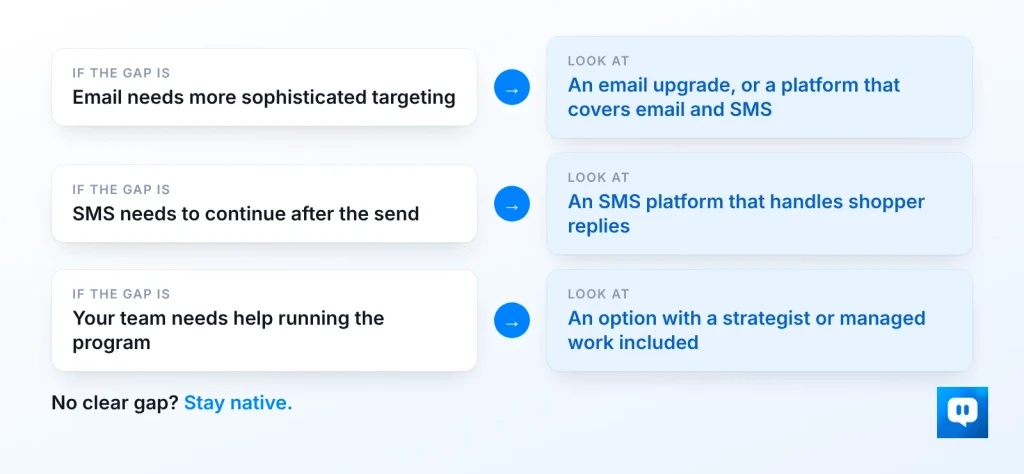
- Email needs more sophisticated targeting or coordinated journeys. An email-and-SMS platform may be a better fit than adding an SMS specialist.
- SMS needs to continue after the send. Shoppers asking about a product or purchase need a way to get an answer over text.
- Your team needs help running the program. Software support, a strategist and someone writing and scheduling campaigns are different services. Choose the level of help you actually need.
Reply handling is a concrete native SMS limitation. In its US and Canada toll-free setup, the sender number is delivery-only and cannot receive customer replies. Automatic responses to keywords such as INFO and HELP are supported, but they are different from an open-ended shopper conversation. That limitation should not be generalized to Shopify Inbox or WhatsApp.
Consider this illustrative example: a merchant’s newsletters and abandoned-checkout emails work well, but product-launch texts prompt questions about size and availability. Native Shopify SMS can send the campaign; the missing capability is answering those questions. The merchant can address that gap while keeping email in place.
The 7 Shopify Messaging alternatives by replacement need
1. TxtCart for keeping native email and building a fuller SMS program
TxtCart is an SMS marketing platform for ecommerce merchants on Shopify. It brings subscriber growth, campaigns, automated flows and two-way shopper conversations into the same SMS program, while email can stay in Shopify Messaging.
A product-launch campaign can bring a subscriber back to the store, and a flow can follow up on relevant shopper behavior. When the shopper replies with a question, the AI Agent can answer using the store’s knowledge and enabled skills, including product search and inventory availability.
In the example above, a shopper asks, “Is the blue one available in medium?” The AI Agent can check the variant’s availability and answer before the shopper buys. It reports availability rather than exact stock counts.
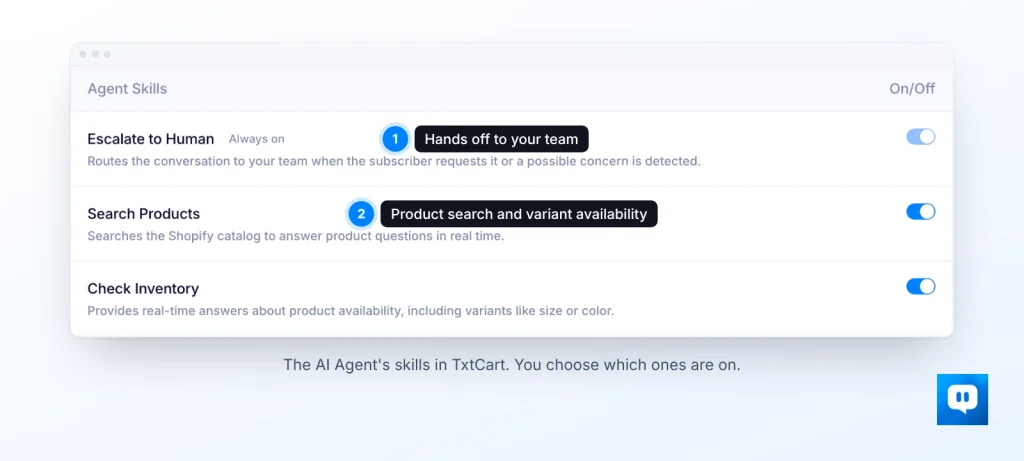
If the question needs human handling, the conversation goes to the merchant’s team in Conversations, TxtCart’s inbox for reviewing message history and replying directly.
SMS signup forms provide the audience for that program. TxtCart supports a configurable form that can collect email followed by SMS, with records syncing to Shopify. Each channel needs its own appropriate permission.
Pricing: TxtCart combines a subscription with messaging and carrier charges, billable AI resolutions and applicable list-growth fees. AI resolutions cost $2.99 each. Escalation does not incur that resolution fee; messaging and carrier charges can still apply.
The List Growth Suite is free for up to 5,000 monthly unique visitors. When its tools are configured and traffic exceeds that allowance, a traffic-based monthly fee applies. Use the current TxtCart pricing for the plan and usage mix you need.
TxtCart is worth evaluating when you want campaigns, lifecycle flows and shopper questions handled in the same SMS program. Your team owns the marketing plan, store information, AI permissions and human follow-up.
2. Klaviyo for moving email and coordinating customer data across channels
Klaviyo is a strong candidate when the reason to leave native is deeper email targeting and more connected customer journeys. Its segmentation and automation tools let teams use customer behavior and commerce data across email and SMS.
A merchant can build different journeys for first-time buyers, repeat customers and lapsed shoppers, keeping the audiences and messages in one environment. That coordination is useful when managing customer data across separate tools has become part of the problem.
Pricing: Klaviyo‘s free plan covers up to 250 active profiles and 500 monthly emails. Its $20-per-month Email plan covers 500 active profiles and 5,000 emails. Both include $5 of mobile messages per month. A larger mobile program needs an additional messaging budget. On dollar-based plans, you purchase a monthly balance upfront, with carrier costs included in the rate; some accounts still use credit-based pricing.
Choose Klaviyo when its shared data and email capabilities solve the problem you are moving for. It can also be used for SMS separately, so moving both channels is a choice rather than a requirement.
3. Omnisend for email and SMS in a shared automation workflow
Omnisend suits a merchant who wants email, SMS and web push to work together without building separate journeys in separate tools. Its automation workflows can combine those channels or run SMS on its own.
For example, a team can manage an email-and-SMS follow-up in one workflow rather than maintain two parallel sequences. Compare that convenience with your actual requirements for segmentation, timing and reply handling.
Pricing: For a merchant switching to Omnisend, SMS requires Pro plus a separate SMS Credits Subscription. The lowest advertised SMS rate depends on spend and destination. Compare the contact plan and SMS budget together; an email-only entry price does not cover the combined program.
Omnisend belongs on the shortlist when you intend to use its cross-channel workflow.
4. Postscript for Shopify SMS with expanding email coverage
Postscript combines SMS campaigns, automations, subscriber acquisition, segmentation and response management for Shopify merchants. Its SMS tools cover both planned sends and triggered journeys.
Postscript has also launched email publicly. Its email product describes shared customer profiles and email and SMS in the same flow. Access is being opened in cohorts, so confirm eligibility and timing before planning an email migration. Our Postscript Email guide explains that consolidation decision in more detail.
Pricing: Postscript Starter has no monthly platform fee but a $49 monthly minimum spend, with SMS usage and carrier fees. Growth is $100 per month plus messaging usage and carrier fees. The minimum is a spending floor, not automatically another $49 added to the same usage bill. Separately packaged AI products and managed services change the total.
Postscript is relevant when you want a Shopify-focused SMS program and may later consolidate email. Its expanding scope does not make moving email necessary if the native program already meets your needs.
5. Attentive for a broader messaging program with support and AI options
Attentive is worth considering when the buying decision involves a wider messaging program and a substantial support relationship. Its packages span SMS, email, RCS and push, with shared customer profiles and cross-channel journeys.
Its pricing page includes strategic support and onboarding, alongside different AI products. AI Essentials is included with all plans; other AI tools and broader packages have their own commercial terms.
Pricing: The exact quote depends on message volume, subscriber list size, channels and selected AI products. Compare the complete package with the work your team needs, including the support and execution included.
6. Seguno for upgrading email inside Shopify admin
Seguno’s email product is a useful alternative when you like working in Shopify but want to change the email tools. It offers email templates, campaigns and automations while keeping the operating environment close to the store.
An email-focused move lets you improve production and automation without changing native SMS or WhatsApp where they already fit.
Pricing: Seguno’s email plans are based on active subscribers and billed through Shopify. Starter is free for up to 250 subscribers. Standard is $35 per month with 2,500 subscribers included, while Professional is $215 with 25,000 included.
Evaluate Seguno’s email product against the campaigns and automations you need. It does not solve an SMS reply-handling problem.
7. Recart for SMS list growth and help running the channel
Recart combines SMS marketing and subscriber acquisition with service options. Its OneClick opt-in and list-growth tools are central to the offer, alongside SMS campaigns and automations.
The service component matters when the constraint is capacity. A merchant may need help designing acquisition forms, planning sends or running campaigns, rather than another software interface to operate. Recart’s plans distinguish support and managed work, so compare those deliverables at the package you would buy.
Pricing: Recart’s List Growth offer starts at $200 per month with a quarterly commitment, plus a $0.020 OneClick verification fee. Its List Growth + SMS offer starts at $500 per month with a quarterly commitment, plus US SMS usage at $0.0085 per message and carrier fees. The $200 offer does not include the SMS program. Confirm the managed work included in the package you choose.
Recart deserves consideration when SMS acquisition and execution support are part of the same buying need. Compare the managed work with the capacity you would otherwise need in-house.
Keeping Shopify email while moving SMS
You can keep Shopify Messaging for email while using TxtCart for SMS. Shopify continues to run the store, and each marketing tool takes responsibility for its assigned channel.
The main operational change is deciding which system sends which messages. Two tools should not both run the same abandoned-checkout SMS sequence simply because both are installed.
| Program area | Where it runs | Your team’s responsibility |
|---|---|---|
| Email campaigns | Shopify Messaging | Manage email segments, templates and the send schedule |
| Email automations | Shopify Messaging, where they still meet your needs | Review timing alongside SMS to avoid overlapping messages |
| SMS campaigns and flows | Your selected SMS platform | Set targeting and flow rules; turn off native SMS sends that would duplicate them |
| SMS replies | Your SMS platform’s supported reply workflow | Assign human follow-up; maintain knowledge and permissions if using AI |
| Consent and unsubscribes | Every tool sending marketing messages | Preserve channel-specific consent records and test opt-out handling across the setup |
For the merchant sending product launches, that can mean a native email campaign alongside an SMS campaign in TxtCart. The SMS conversation can continue when a shopper asks about a size, using the AI Agent’s product skills or a handoff to the merchant’s team.
Test how consent and unsubscribe records move through your exact setup before launching. Check event and engagement fields and unsubscribe handling separately; they may not sync in both directions.
If you also use Klaviyo, onward subscriber transfer through Shopify depends on your configuration. It is not a direct TxtCart-to-Klaviyo sync.
What a Shopify Messaging replacement will cost and change
Compare the program you plan to run, including the work around the messages. A low entry price can cover email only, a limited allowance, a longer commitment or software without campaign execution.
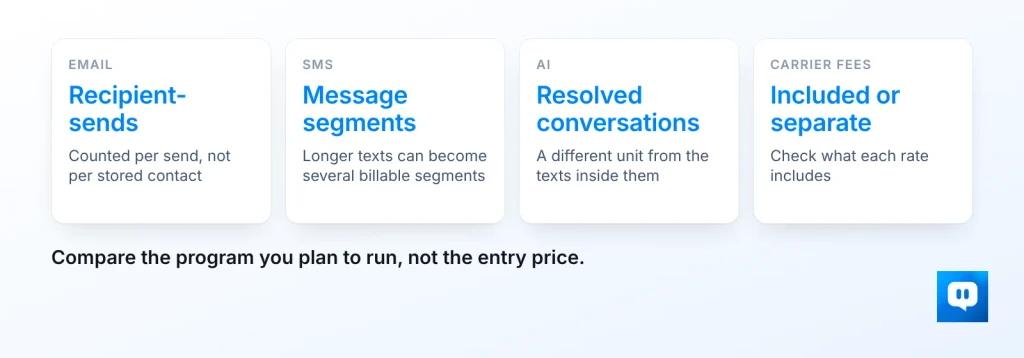
For SMS, count message segments across campaigns and automations, then add applicable platform, carrier, number and AI fees. A resolved AI conversation is a different billing unit from the texts exchanged within it. TxtCart’s billing guide also lists inbound and undelivered messages as billable at standard SMS/MMS rates.
Klaviyo’s dollar-based mobile rates include carrier costs, while Postscript shows them separately. Check what each rate includes before adding a carrier fee.
An illustrative native Shopify bill
Suppose the merchant in our example sends exactly four campaigns in one calendar month to 12,000 eligible recipients on each channel. For SMS, assume opted-in US subscribers, one segment per message and one approved toll-free number.
| Native channel | Monthly calculation | Monthly cost (USD) |
|---|---|---|
| (48,000 sends − 10,000 free sends) ÷ 1,000 × $1 | $38.00 | |
| SMS | 48,000 single-segment messages × $0.012 + $2.15 for one toll-free number | $578.15 |
Shopify’s email pricing counts recipient-sends, not stored contacts. Ordinary email automations use the allowance, while abandoned-checkout emails are free and excluded. Its SMS pricing charges by message and destination, with longer texts potentially creating multiple billable segments.
All prices are in USD. The example excludes other billable messages, taxes and the Shopify subscription, and assumes no other chargeable email sends that month. It explains the billing units, not which channel produces more value or whether another platform costs less.
Switching SMS away from Shopify Messaging
Before moving SMS, preserve the subscriber’s consent and suppression records along with the phone number. Map the live flows you need to recreate and identify which existing sends will stop. A new sending tool should not accidentally create a second version of the same program.
Confirm supported countries and sender arrangements before assuming an existing number can move. Also compare reporting definitions: a platform change can alter attributed revenue without proving that the new program caused an equivalent sales increase.
Assign an owner to test the forms, automations, replies and unsubscribe handling before the new SMS program goes live.
Which Shopify Messaging alternative fits your store
Stay with Shopify Messaging when its native campaigns and automations cover your program. The convenience of working inside Shopify is valuable, and a second platform should earn its place.
For an email upgrade, compare Klaviyo, Omnisend and Seguno against your targeting and production needs. For coordinated channels, evaluate the shared journeys and commercial scope of the broader platforms. For help running SMS, compare the execution included in Recart’s and other service offers.
TxtCart fits the merchant who wants to keep email working and give SMS more responsibility: growing the subscriber list, reaching relevant audiences, running lifecycle flows and answering shopper questions through the AI Agent, with the merchant’s team handling escalations.
For that decision, the TxtCart vs Shopify Messaging comparison goes deeper on SMS fit. Or book a demo to see how your campaigns, flows and shopper conversations could work together.
Ready to grow?
Make SMS your next big revenue channel.
Join 4,000+ ecom brands growing their subscriber list, automating their marketing, and turning conversations into revenue with TxtCart.