
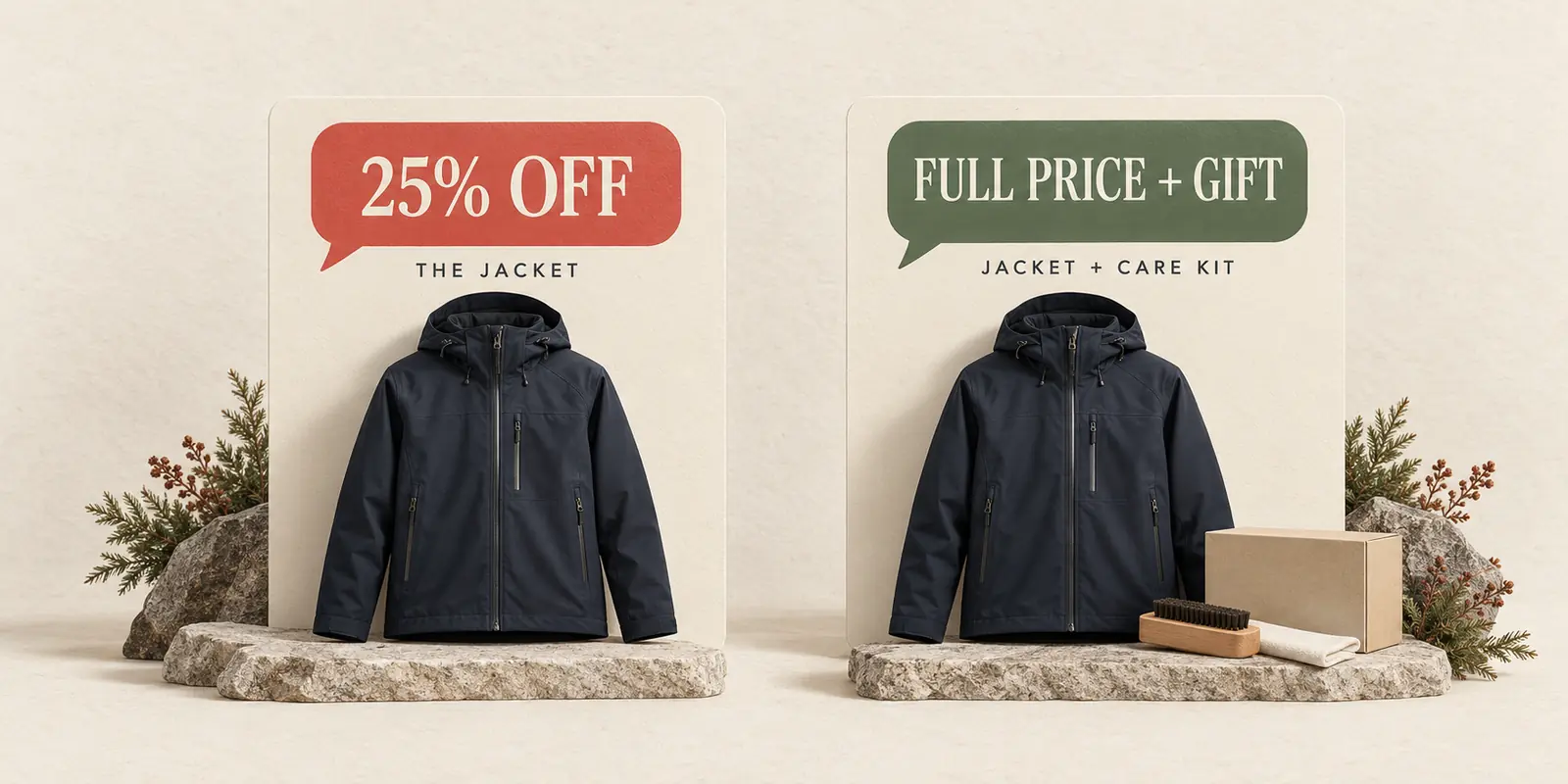


A 25% discount on a $100 product gives away $25 in revenue. A relevant gift that costs you $5 could leave more money per order. Whether that gift wins your Black Friday sale depends on how many shoppers still buy at full price.
Choose your BFCM SMS marketing offer by comparing what it leaves after conversion and costs, then carry the same terms from the text through checkout. A campaign can generate impressive sales and still leave too little after the offer is delivered.
Black Friday and Cyber Monday (BFCM) give Shopify brands several ways to make an offer worth acting on: savings, a useful gift, a complementary bundle or access before the public launch. The right choice depends on your products, audience, stock and delivery costs.
TxtCart is an SMS marketing platform for Shopify stores. Choosing the offer comes first; the platform helps you promote it, follow up and answer buying questions. For audiences, timing and the full send calendar, use our Black Friday SMS campaign plan.
Key takeaways
- Compare the whole campaign: a higher contribution per order only helps if enough shoppers buy.
- Choose a benefit your audience values and your stock and fulfillment can support.
- Keep the offer consistent from signup through checkout; account for welcome and recovery incentives.
- Answer product and eligibility questions before deciding that a shopper needs another discount.
Compare BFCM offers by contribution after costs
Start with a representative order: what the customer pays after the offer, less the costs of supplying it. Compare that contribution across offers before accounting for campaign spend.
Consider this illustrative example: a product sells for $100, costs $40, and has another $10 in variable order costs. You could discount it by 25%, or keep the full price and include a gift that costs $5.
| Illustrative order economics | 25% off | Full price + gift |
| Customer pays | $75 | $100 |
| Product cost | $40 | $40 |
| Other variable order costs | $10 | $10 |
| Gift cost | $0 | $5 |
| Left per order, before marketing | $25 | $45 |
The gift leaves $20 more per order in this simplified example. That assumes the other costs stay unchanged: the gift does not add a parcel, increase shipping or change the $10 cost allowance. Use your actual packaging, fulfillment, payment and return costs when applying the comparison.
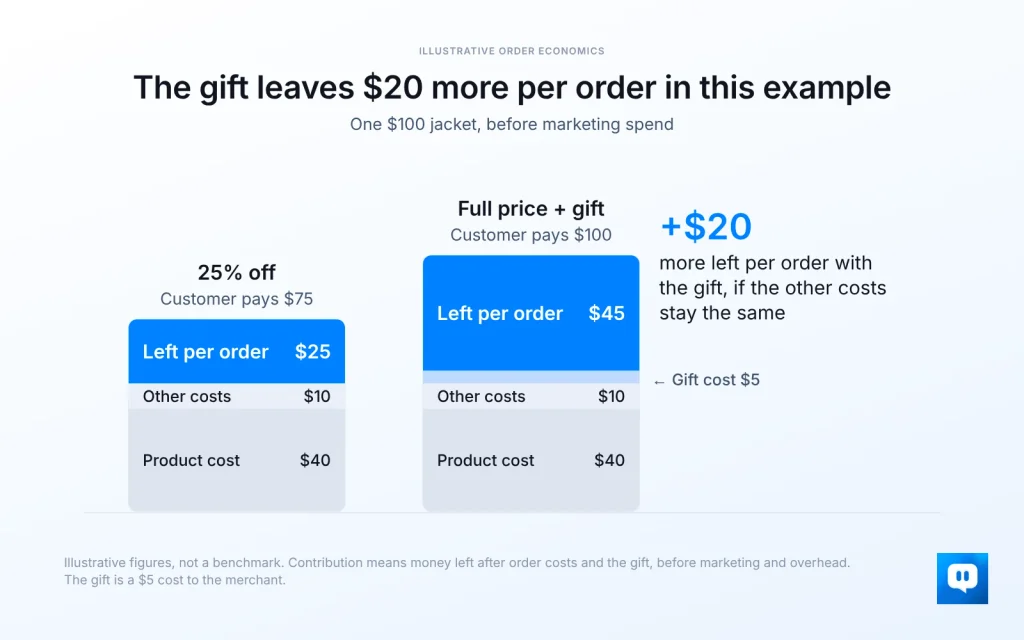
Contribution is the amount left to cover marketing, overhead and profit. It is not the business’s net profit. Because the selling price already reflects the discount, you should not subtract it again.
Conversion can change the winner
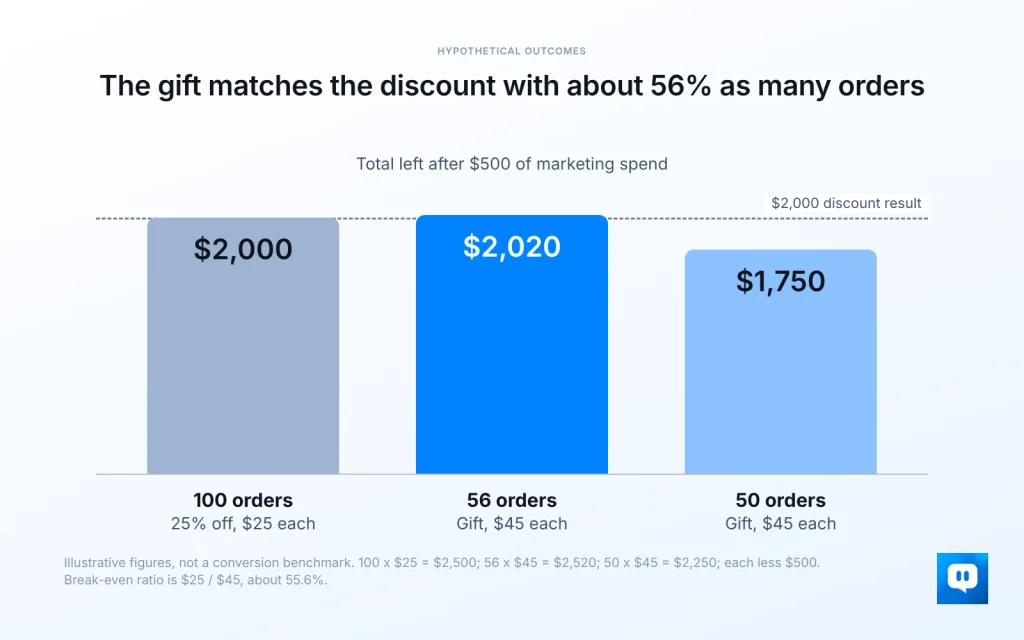
Now suppose you reach comparable audiences and spend $500 on marketing for each offer. These are hypothetical outcomes:
- 100 discounted orders: 100 × $25, less $500 in marketing, leaves $2,000.
- 56 gift orders: 56 × $45, less $500 in marketing, leaves $2,020.
- 50 gift orders: 50 × $45, less $500 in marketing, leaves $1,750.
Under these assumptions, the gift needs about 55.6% as many orders to match the discounted offer’s total contribution. It can bring in fewer orders and still leave more money, but only up to a point.
A gift shoppers do not want may not persuade enough of them to pay full price. A discount might convert enough additional orders to make up for the smaller contribution on each one. Compare both the order economics and the number of orders the offer produces.
Pairs well with TxtCart

17TRACK Order Tracking
17TRACK helps Shopify merchants provide a better post-purchase experience with branded tracking pages, real-time shipment tracking, and automated shipping notifications.
Choose a BFCM offer that fits your products and shoppers
Once you know what you can afford, choose a benefit the shopper has a reason to value. A useful accessory, a ready-made gift set and first access to a limited collection solve different buying problems.
| Offer | When to consider it | Cost or tradeoff to weigh |
| Percentage or fixed savings | A clear price incentive on selected products or a qualifying basket. | Revenue given up on each order, including buyers who may have paid full price. |
| Gift with purchase | A desirable item complements the purchase at a manageable cost. | Gift, packing and shipping costs, weighed against how much shoppers value the gift. |
| Product bundle | A useful set makes the purchase easier or adds a relevant complementary item. | The contribution of the entire basket after every added product and delivery cost. |
| Spend threshold or free shipping | The benefit gives shoppers a reason to build a larger eligible basket. | Discount or shipping subsidy and whether the threshold is within reach. |
| Early access | Existing fans value first choice or access before the public sale. | Stock availability and the cost of any additional benefit; access must open before the public sale. |
For bundles, cost the whole basket. Adding a second product can raise order value while also adding product, packaging and shipping costs. A jacket and care kit may be a useful combination; an unrelated clearance item adds little reason to buy. Our Shopify bundle strategies guide covers the formats in more detail.
An upsell needs the same discipline. Recommend a higher-priced product when its additional benefits suit the shopper’s needs. A more expensive replacement that does not solve their problem can make the purchase harder.
If a bestseller is likely to sell through at full price, consider what you gain by discounting it. Slower stock may deserve a different offer, but pairing it with a popular product only helps if the combination makes sense to the shopper.
Match the audience to that choice. Subscribers interested in outerwear have a reason to consider a jacket-and-care-kit offer. Loyal customers might value first access without needing a deeper discount. Define the qualifying group and the benefit before writing “VIP” in the text.
Write BFCM SMS offers with clear value and conditions
Your message should help the shopper understand what they get, what qualifies and how to claim it. A gift offer needs different copy from a percentage discount because the conditions can change whether the basket qualifies.
For example, these are adaptable, illustrative messages:
[BRAND]: Black Friday: get a care kit with $100 in eligible full-price outerwear. Add the kit to your cart; no code needed. Ends [DATE/TIME/TIMEZONE]: [LINK]. [Opt-out line]
[BRAND]: Our Black Friday jacket + care kit bundle is [PRICE]. See included styles, sizes and terms: [BUNDLE LINK]. Available until [DATE/TIME/TIMEZONE]. [Opt-out line]
In the gift example, the shopper knows the threshold, the eligible category and the redemption step. The linked page should make any further material exclusions clear, including whether other discounts affect eligibility. Replace every placeholder and use the sender identification, disclosures and opt-out wording required for your program.
The redemption instruction must match your store. With Shopify’s native Buy X Get Y discounts, customers must add the qualifying products and the gift to their cart; an automatic discount does not automatically insert the gift. If a separate app handles that step, write the message for that actual experience.
Early-access copy also needs a concrete promise. Say what opens, who qualifies and when the public sale starts. If you invite visitors to subscribe for early access, make that benefit clear in the signup experience. TxtCart’s List Growth tools can help collect subscribers; the access benefit and the required SMS marketing permission still need to be clear.
Use the BFCM SMS templates for more copy options once the offer is settled. Choose the message that fits the shopper’s next step rather than turning every example into another scheduled send.
Prevent conflicting welcome, BFCM and cart-recovery offers
Imagine a shopper signs up for SMS and receives a 10% welcome code. They then see your Black Friday gift offer, start checkout and leave. A recovery flow sends another discount.
You intended one sale benefit. The shopper now has several promises to interpret, and your checkout settings decide which ones apply. Unsupported combinations can produce a checkout error; permitted combinations can cost more than your original offer calculation allowed.
Before launch, follow the offer through the places that shopper encounters it. For the illustrative outerwear promotion, a consistent version could look like this:
| Shopper touchpoint | Offer to communicate | Decision behind it |
| Signup and welcome | The actual seasonal benefit and its eligibility. | How previously issued welcome codes interact with it. |
| BFCM campaign | A care kit with $100 in eligible full-price outerwear. | Qualifying products, redemption step, exclusions and deadline. |
| Checkout follow-up | The existing gift benefit, if the basket still qualifies. | Whether an additional incentive is justified and affordable. |
| Checkout | The promised benefit on the qualifying basket. | The supported discount combinations and actual cart behavior. |
Shopify’s supported discount combinations and your store settings determine which benefits can apply together. Make that decision before launch, including how previously issued welcome codes interact with the sale.
A checkout reminder can bring the shopper back to the gift they already qualify for. With TxtCart Flows, you can build that follow-up around the existing offer. Adding another discount is a separate decision: cost the combined benefit before offering it.
After the purchase, end reminders for that checkout and reconsider other pending promotional messages. The journey should reflect what the shopper has already done.
Answer shopper questions before offering another discount
Sometimes the offer is attractive and the shopper still needs an answer. The question could be whether a particular color qualifies, whether the care kit suits the jacket, or whether the bundle includes the size they need.
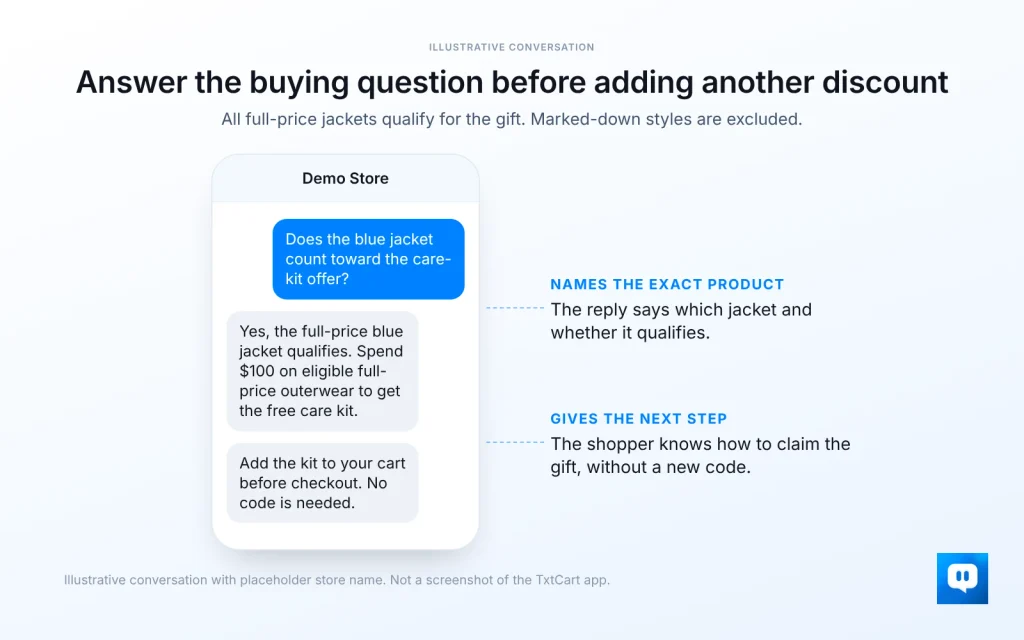
For example, suppose all full-price jackets qualify for the gift, while marked-down styles are excluded. A shopper asks, “Does the blue jacket count toward the care-kit offer?”
For a qualifying full-price blue jacket, an illustrative reply could be:
“Yes, the full-price blue jacket qualifies. Spend $100 on eligible full-price outerwear to get the free care kit.”
“Add the kit to your cart before checkout; no code is needed.”
With the relevant skills enabled, TxtCart’s AI Agent can search the connected Shopify catalog, check variant availability and recommend relevant products. In a Flow conversation, those capabilities and the offer terms you supply can help answer the jacket question while the shopper is deciding.
The Agent can offer discounts configured for the shopper’s flow. Your team handles exceptions outside the supplied information and offer policy.
Measure BFCM SMS offers beyond attributed revenue
Return to the decision you started with. Did the chosen offer produce enough orders at a contribution you can afford? The gift’s $45 per order only helped in the example when enough shoppers bought it.
Compare offers across similar audiences and the same attribution window. Start with revenue after discounts and refunds, then subtract product, gift, fulfillment, messaging and relevant platform costs. Treat cancellations and returns consistently, and avoid deducting the same discount or refund twice.
Also look at what made the result harder or more expensive to earn: a bundle that changed the product mix, a gift that ran out mid-campaign or repeated questions about eligibility. Those questions can reveal unclear copy. Rising opt-outs are a reason to review whether reminders reached the right audience and offered something useful.
Attributed revenue tells you which orders a campaign received credit for. Your costs tell you what those orders left the business. Neither a revenue report nor a before-and-after change proves that SMS caused additional purchases.
When comparing with a previous promotion, account for changes in audience, stock and product mix as well as the seasonal period. For a test, change the offer while keeping the audience and timing comparable; changing all three makes the result hard to interpret.
BFCM SMS offer FAQs
Which BFCM SMS offer should I send?
Choose the offer that produces the strongest total contribution for the relevant audience after conversion and costs, within your stock and fulfillment limits. Discounts, gifts, bundles and early access can all be appropriate. Start with the order economics, then judge whether enough shoppers value the offer to act.
Is a percentage discount or a free gift better for margin?
A gift can leave more per order when its cost is lower than the revenue given up through a discount. In the illustrative comparison above, the gift leaves $45 before marketing versus $25 for the discounted order. Conversion and additional gift costs determine which campaign leaves more overall.
Should I run early access or VIP offers by SMS?
Yes, when the audience has the necessary marketing permission and receives a genuine benefit, such as access before the public launch. A VIP offer does not have to mean the deepest discount. Define who qualifies and avoid calling an offer exclusive when everyone can already use it.
How do I stop offers from conflicting?
Account for active popup, welcome, campaign, recovery, email and checkout incentives. Decide which should combine, make the terms consistent and confirm how supported Shopify discount combinations behave in the actual cart. Do not assume a new seasonal campaign changes existing flows or previously issued codes.
What happens when shoppers reply to an offer text?
When enabled, TxtCart’s AI Agent can answer replies to campaign texts as well as Flow messages, using available product information, policies and the relevant enabled skills. Conversations that need an exception or a person can be escalated to your team.
Run your BFCM offer with TxtCart
The best BFCM offer is one enough shoppers value that still leaves your business enough after costs. The winner is the one enough shoppers value that still leaves the business enough after delivery. Make the same promise in the text, follow-up and checkout.
TxtCart helps a lean Shopify team carry that choice into the SMS program. Growth and higher plans include subscriber segmentation and A/B testing, so you can compare offers with a defined audience. TxtCart Campaigns reports attributed revenue; your own cost data completes the contribution comparison.
For the outerwear promotion, Flows can remind an eligible shopper about the care kit without automatically adding a deeper incentive. The AI Agent can help answer product questions in that Flow conversation, with your team handling exceptions. You keep control of the offer; TxtCart supports the sends, follow-ups and shopper help around it.
Explore TxtCart Campaigns to put your BFCM offer into practice. If you need help assessing campaigns, follow-ups and replies together, book a demo.