



A shopper adds a jacket to their cart, then texts back: “Does this run true to size?” That reply is where a broadcast ends and a conversation can begin.
Most SMS marketing is built for sending: a promotion, a restock alert, a cart reminder. Conversational SMS is built for what happens when the customer answers. The next response should understand the question, use the right context, and help the shopper move forward.
That response might come from a person, automation, or both. What makes the exchange conversational is not who replies. It is whether the reply carries context forward and leads to an answer, an action, or a clean handoff.
What is conversational SMS?
Conversational SMS is an approach to text messaging built around replies, context, and appropriate handling. A customer can answer a message, ask a question, and receive a response that reflects what they actually need.
For an ecommerce brand, that could mean answering a sizing question before checkout, resolving hesitation after a shopper abandons a cart, checking an order, following up on feedback, or moving a complex issue to the right person without losing the conversation history.
AI can help brands manage those exchanges at scale, but AI is not required for an interaction to be conversational. A well-informed team member can run a conversational exchange manually. An automated message can still feel like a broadcast if it ignores the customer’s question and sends the same canned response every time.
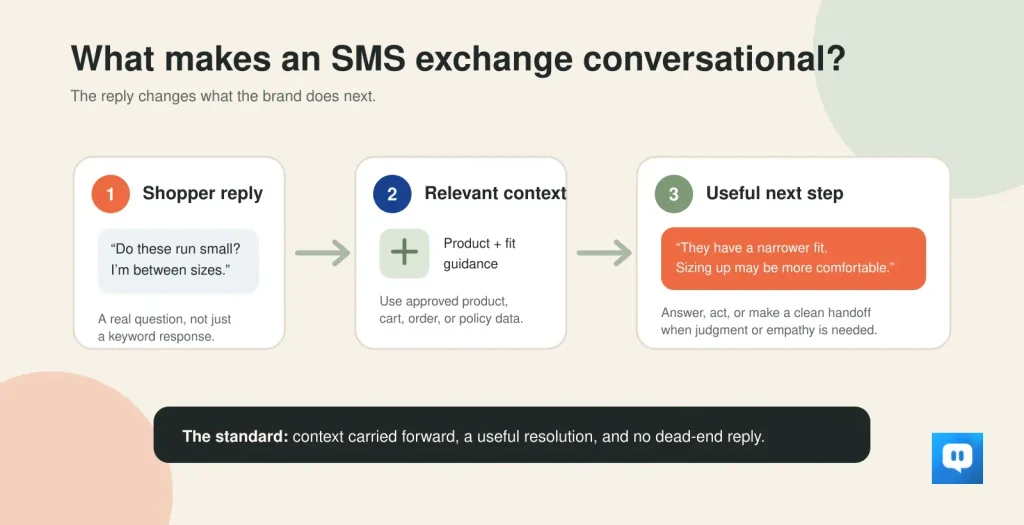
Conversational SMS vs. two-way SMS vs. broadcast SMS
These terms describe different parts of the messaging experience. Broadcast describes a sending pattern. Two-way SMS describes the ability to exchange messages. Conversational SMS describes how the reply is handled.
| Model | What happens | What it requires | Best fit |
| Broadcast SMS | The shopper receives a cart reminder. No reply is expected or meaningfully handled. | A send tool, a list, and a clear message. | Promotions, announcements, restock alerts, and straightforward reminders. |
| Two-way SMS | The shopper replies, “Does this run small?” and the message reaches the brand. | A number that can receive and route replies. | Confirmations, feedback, service exchanges, and reply-enabled campaigns. |
| Conversational SMS | The reply is understood in context, answered with the relevant sizing detail, and followed by a useful next step. | Context, an equipped person or automation, and a clear path to human help. | Product questions, cart hesitation, support, recommendations, and guided follow-up. |
A two-way campaign becomes conversational when the brand is prepared to understand and handle the reply. Inviting a response is not enough if that response goes unanswered or triggers a generic keyword message.
For a closer look at the underlying exchange capability, read TxtCart’s two-way SMS marketing guide.
Why conversational SMS matters for ecommerce
A broadcast can drive a click. A conversation can resolve the reason someone has not bought. Those are different jobs.
Many purchases stall on a small unanswered question: fit, delivery timing, ingredients, compatibility, inventory, or returns. Sending another discount does not resolve that uncertainty. Giving the shopper a direct reply path can.
- Resolve a purchase objection while the shopper is still engaged.
- Handle routine questions without sending every reply to the support queue.
- Preserve context when a person needs to step in.
- Turn repeated questions into useful feedback for product pages, policies, merchandising, and support content.
The useful unit is not the reply by itself. It is the resolution. A high reply rate means little if shoppers receive incomplete answers or the team inherits a larger backlog.
What the results can look like
Published customer results show why the model is worth examining, but they should be read as individual outcomes, not a promise for every store.
TxtCart’s published Organi case study reports $1,248,723 in SMS-attributed revenue, 16.9x SMS-attributed ROI, and a 32% cart recovery rate. Organi’s founder describes customers valuing personalized texts and the ability to get questions answered without moving to another support channel.
The published Chaser case study reports $207,341 in revenue recovered, 10.8x ROI, and a 54% cart recovery rate. These figures describe the programs run by those brands. They do not isolate conversation handling as the only cause or establish a universal benchmark.
Where conversational SMS fits in the customer journey
The strongest use cases are moments where a reply can change what happens next. That is a better filter than asking where another automated text could be added.
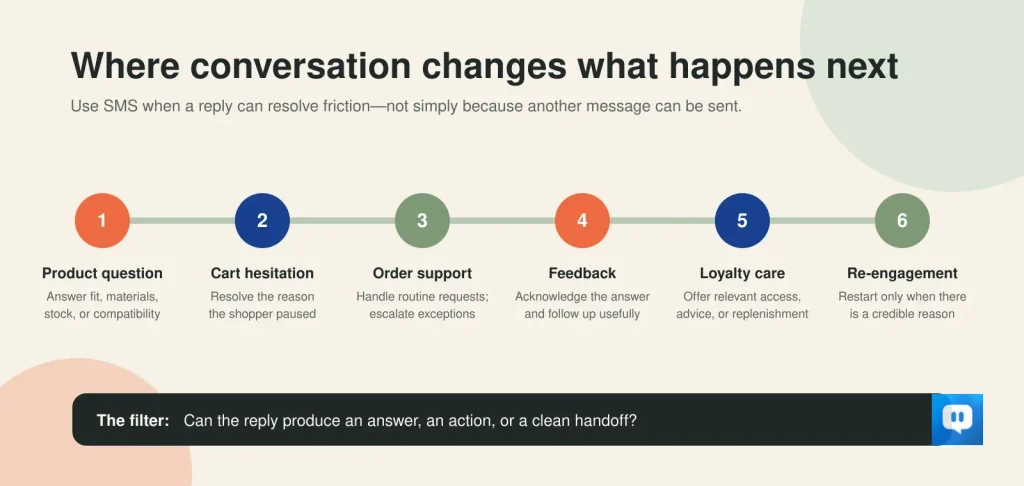
1. Pre-purchase product questions
A shopper may be interested but unsure about fit, materials, ingredients, compatibility, availability, shipping, or returns. The reply job is to answer the question accurately and make the next step easy.
Shopper: “I’m usually between a 9 and 10. Do these run small?”
Brand: “They have a narrower fit. If you prefer more room, sizing up may be more comfortable. Want the size chart for the pair in your cart?”
2. Cart hesitation
A cart reminder becomes conversational when the shopper can explain why they paused. The reason may be delivery timing, returns, price, fit, stock, or trust. The job is to address the actual objection, not send a sequence of increasingly large discounts.
Brand: “Still deciding on the trail shoes in your cart? Reply with any questions.”
Shopper: “Can I exchange them if the size is wrong?”
Brand: “Yes. Exchanges are available under our return policy. Here’s the policy, and your cart is still saved: [link]”
3. Post-purchase support
Order status, address changes, returns, exchanges, and product-use questions are natural conversational moments. Automation can handle approved, well-defined requests when reliable order and policy information is available. Delays, disputes, damaged orders, safety concerns, and policy exceptions should move to a person.
4. Feedback with follow-up
A rating request is not automatically conversational. It becomes useful when the brand responds to what the customer says. A low score may need a support handoff. A detailed suggestion may reveal a product or experience issue worth fixing. Not every response needs to become another sales attempt.
5. Loyalty and high-value customer care
Repeat customers can use SMS for early-access questions, restock requests, product advice, replenishment, and help before a purchase. The value comes from access and relevance, not manufactured familiarity.
6. Selective re-engagement
Re-engagement works best when there is a credible reason to restart the conversation, such as a restock, a relevant product update, or a question tied to known interest. Segment by engagement and purchase context, monitor opt-outs, and stop when the audience signals that the message is no longer useful.
What does not automatically belong here?
Welcome messages, birthday offers, product launches, drip sequences, referrals, and general promotions usually belong to campaigns or flows. They become conversational only when the design invites a real reply and the brand is equipped to handle what comes back. Appointment reminders and broad lead-generation examples are outside the core ecommerce job of this guide.
For a larger collection of message patterns, see these conversational SMS examples.
Decide what automation should handle and when a person takes over
A conversational SMS program needs clear operating boundaries. Automation works best when the task is predictable, the source information is current, and the allowed response is well defined. People should take over when the situation calls for judgment, empathy, investigation, negotiation, or a policy exception.
| Interaction | Good automation candidate | Route to a person when |
| Product basics | The answer exists in approved product information and the question is straightforward. | The shopper needs advice beyond the available information or the answer could create risk. |
| Shipping and returns | The policy is current, clear, and relevant to the product or order. | The request involves an exception, dispute, delay, damage, or unclear policy. |
| Cart hesitation | The response can answer a known question or provide an accurate product or policy link. | The shopper needs negotiation, a special exception, or a recommendation that requires judgment. |
| Order questions | Reliable order context is available and the next step follows the normal process. | The order falls outside the normal flow or the customer is upset, confused, or at risk. |
| Feedback | The system can acknowledge a simple response and ask one relevant follow-up question. | The customer reports a serious problem or expects a resolution. |
| Sensitive issues | A basic acknowledgement and immediate routing may be appropriate. | A trained person should take ownership of the conversation. |
The handoff should preserve the full thread. A customer should not have to repeat the question because the interaction moved from automation to a team member. Your team also needs one place to review the conversation and take over when required.
How TxtCart approaches conversational SMS
TxtCart’s AI Agent is built for sales and support conversations over SMS. According to the current product page, it can answer product and support questions, recommend products, handle objections, recover carts, and escalate to a team member. AI and the team can work from the same conversation context in a unified inbox.
Merchants can provide brand guidance, product knowledge, policies, offers, guardrails, and escalation rules. That control matters because a fast answer is only useful when it is accurate and stays inside the decisions the brand has approved.
For deeper coverage of the technology and AI-specific use cases, read the generative AI for SMS marketing guide.
How to evaluate a conversational SMS platform
A platform should be judged by how well it handles a reply, not simply whether it can receive one. Ask:
- Can shoppers reply naturally to campaigns, flows, and cart messages?
- What context can the system use, including catalog, customer, cart, order, inventory, and policy data?
- Can the team define what gets automated, what must never be improvised, and what routes directly to a person?
- Does the full conversation move with the handoff?
- Can the team review conversations, correct information, and control offers or policy language?
- Does it fit the commerce platform and data your store uses today?
- Can you measure replies, resolutions, escalations, opt-outs, assisted purchases, and revenue attribution with a clear methodology?
- What tools support consent, opt-outs, quiet hours, deliverability, and operational ownership?
An auto-reply is not a conversational system. The platform should be able to carry a thread, use relevant context, and know when it has reached its limit.
Conversational SMS best practices
Invite a useful reply
“Reply if you have questions” is easy to ignore when the shopper does not know what help is available. Give them a clear reason to respond, and only invite the reply when the brand has the information and process to handle it.
Answer the question before adding an offer
If the shopper asks about delivery, start with delivery. If they ask about fit, answer the fit question. Forcing a promotion into every exchange makes the interaction less useful and can hide the reason the shopper replied.
Match frequency to intent and consent
There is no universal weekly send count or perfect send time for every store. Frequency should reflect why the subscriber opted in, how engaged they are, the message type, applicable rules, and results in your own data.
Conversational capability does not remove consent obligations. Get appropriate permission, identify the sender, honor opt-outs, and follow applicable sending-time and content requirements. Your business remains responsible for its legal and compliance program.
Use this SMS marketing compliance guide as a starting point, then have qualified counsel review the requirements for the markets where you operate.
Write for the exchange, not a character counter
Keep messages clear and compact, but do not treat 160 characters as a universal rule for good conversation. Length and encoding can affect message segmentation and cost. If the answer needs more detail, link to an accurate source or move the request to the right support path.
Measure the conversation, not only the send
Useful metrics depend on the reply job. They may include meaningful reply rate, resolved conversation rate, escalation rate, response time, assisted purchase rate, cart recovery, opt-outs, complaint signals, recurring question themes, and revenue attribution. No single metric proves the program is working.
Frequently asked questions
What is conversational SMS?
Conversational SMS is text messaging built around replies, context, and useful next steps. A shopper can respond and receive an answer or handoff that reflects the situation instead of another one-way message.
How is conversational SMS different from two-way SMS?
Two-way SMS describes the ability to exchange messages. Conversational SMS describes how the exchange is handled. A reply becomes conversational when the brand uses the shopper’s intent and context to provide a relevant response or next step.
Does conversational SMS require AI?
No. A person can manage a conversational text exchange. AI can help handle appropriate product, support, and selling workflows at greater volume, but it should work within clear guardrails and escalate when a person is needed.
Where can ecommerce brands use conversational SMS?
Strong use cases include pre-purchase product questions, cart hesitation, post-purchase support, feedback with follow-up, high-value customer care, and selective re-engagement. The best opportunities are moments where a reply can change what happens next.
When should a human take over?
A person should step in when the request involves judgment, empathy, a policy exception, sensitive information, a dispute, or anything the system cannot answer confidently. The full conversation should carry into the handoff.
Turn shopper replies into useful next steps
Conversational SMS works when the reply changes what the brand does next. The shopper asks a question, the response uses the right context, and the exchange ends with an answer, an action, or a clean handoff.
Start with one high-intent moment. Define the reply job, the information required, and the automation boundary. Then measure whether the conversation actually resolves friction for the shopper and creates a useful outcome for the business.
Want to see how TxtCart handles ecommerce sales and support conversations? Book a demo to walk through the AI Agent, the unified inbox, and the handoff model using your own customer journeys.